

Online Retro Board: The Best Boards for Sprint Retrospectives in 2026
An online retro board sounds like a solved problem. Columns, sticky notes, dot votes. How different can they be?
Quite different, it turns out. After you've facilitated a few hundred sprint retrospectives, the gap becomes obvious: some boards hold sticky notes, and some boards run the meeting for you. The first kind gives you a place to type. The second kind hides cards until reveal, merges the four different phrasings of "our CI is flaky" into one group, enforces vote limits so the loudest person can't spend twelve dots, and won't let the session end without action items that have owners.
That gap is what this page sorts by.
What an Online Retro Board Actually Needs
Before the picks, the checklist. A board missing more than one of these is a shared doc with columns drawn on it.
- Anonymous input, hidden until reveal, because people soften feedback when their name is attached and everyone's watching them type
- Dot voting with a per-person limit, so priorities reflect the team and not the most enthusiastic clicker
- Grouping, ideally assisted, because every retro produces five cards that say the same thing differently
- Action items with an owner and a due date, exportable to wherever work actually lives
- A timer everyone can see, since retros without one drift to 90 minutes
- History, so next sprint you can check whether anything changed
Templates matter less than tools pretend. Any board can draw Went Well / Didn't Go Well. What you're really buying is the facilitation machinery around the columns.
The Best Online Retro Boards in 2026
1. Kollabe
Kollabe is the deepest retro board you can open in a browser right now. It clears every item on the checklist, then keeps going: over a thousand templates plus an AI generator that builds one from a sentence, AI grouping that actually merges duplicates instead of stacking them, inline polls mid-session, themed boards, kudos, a drawing canvas, and proper async support for the teammate who's three time zones away. Standups and planning poker live in the same login, so the board can quietly become your whole ceremony stack. It's free for up to ten people per room, and paid is $29 a month flat per team rather than per head. The honest gaps: no Slack or Teams integration, no SOC 2, no mobile apps. If those aren't blockers, this is the pick. The full review has the details.
2. EasyRetro
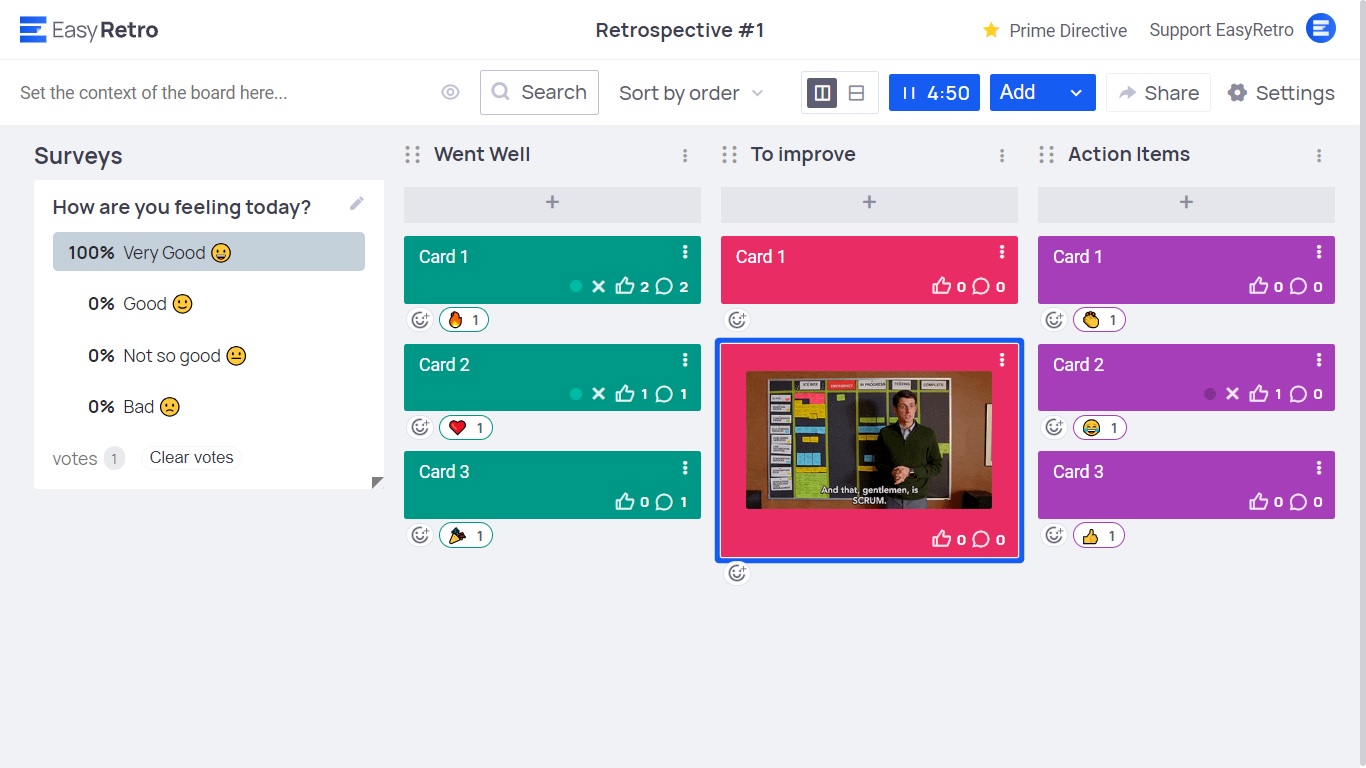
EasyRetro is the board your team understands in thirty seconds. It's been around since the FunRetro days, the template library is huge, and unlimited people can join a board without friction. There's little AI and thin analytics, and the free plan allows exactly one board at a time — but as a plain, reliable retro board, it's earned its longevity. Kollabe vs EasyRetro is the depth-versus-simplicity tradeoff in one page.
3. Parabol
Parabol is less a board than a guided meeting that contains one. It walks the team through reflect, group, vote, and discuss phases in order, which is a gift for a first-time facilitator and a straitjacket for an experienced one who wants to improvise. The free tier is the most generous in the category (two teams, unlimited users), and it's open source with real Slack and Teams integrations.
4. Metro Retro
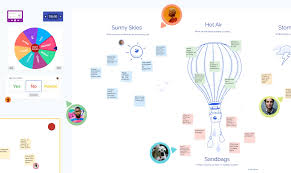
Metro Retro is the most fun of the five, full stop. It's a canvas-style board with confetti, hats, and a spinner, and teams that dread retros perk up on it. Two caveats: the infinite canvas brings some of the same sticky-hunting as a whiteboard, and the free plan was removed in September 2024, so it now starts at $4 per member per month.
5. RetroBoard
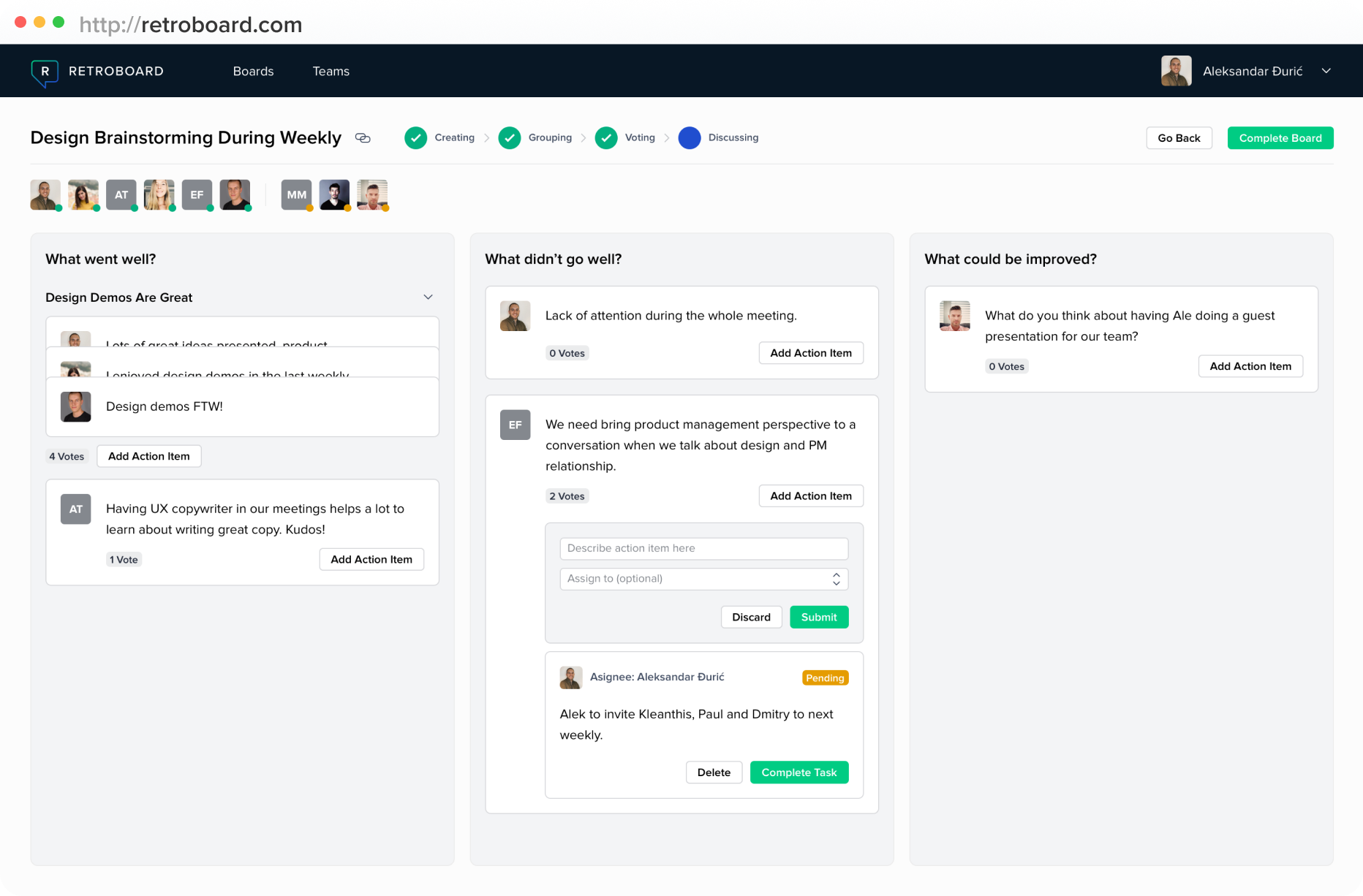
RetroBoard exists for one situation: the retro starts in five minutes and nobody has an account anywhere. No signup, completely free, columns and votes only. It fails most of the checklist, with no action items and no history, but instant and free is its own kind of feature.
The anonymity item on the checklist is the one teams skip and regret. On boards where names show while people type, watch what happens: cards get shorter and safer, and the sprint's real problems stay in DMs. Hidden-until-reveal is the whole point of writing things down instead of just talking.
When a Whiteboard Is the Better Board
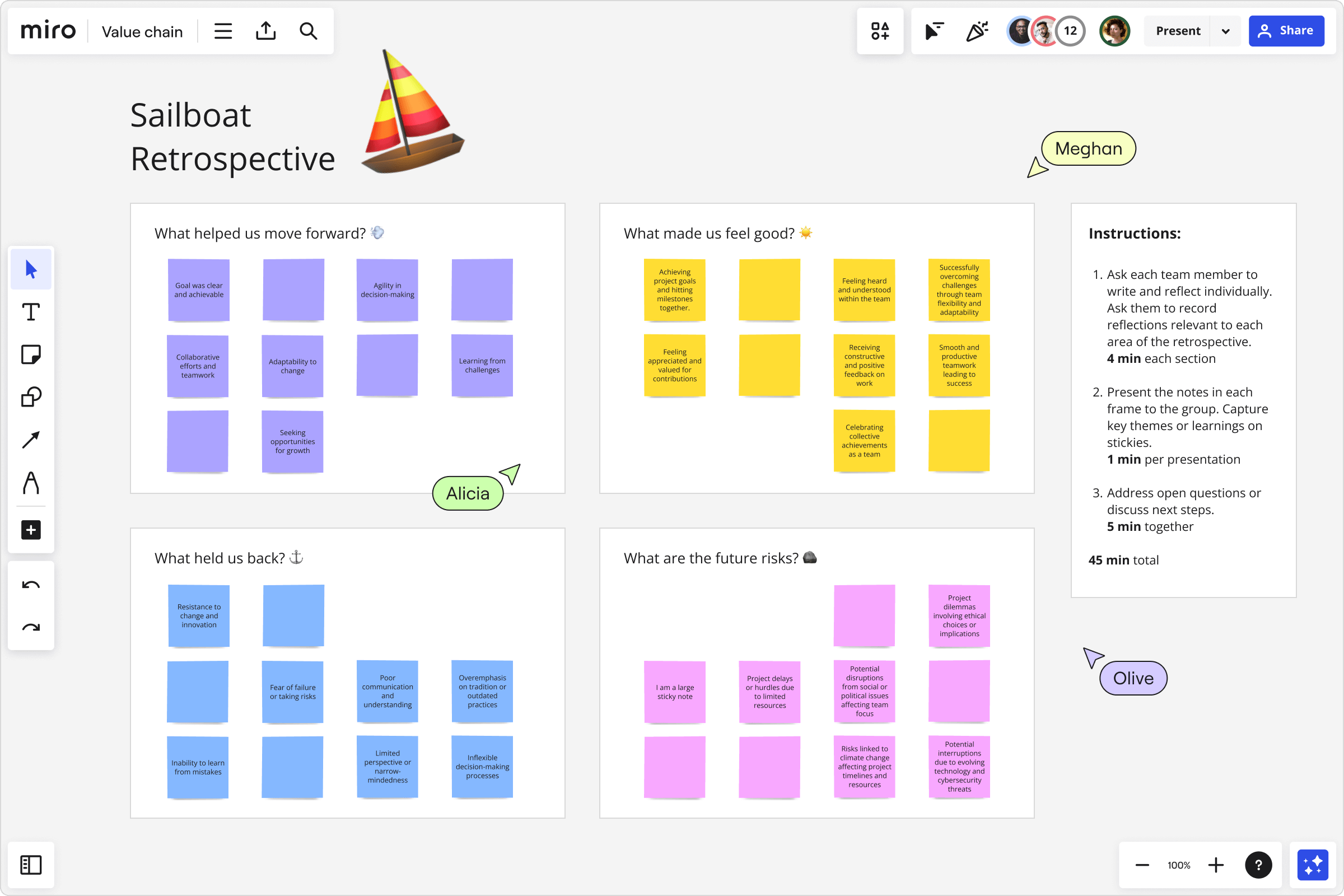
If your company already runs on Miro, the calculus changes. A retro board is one template away, the integration list is the best in the category, and nobody has to approve a new vendor. You give up the facilitation machinery — vote limits, phases, action-item tracking come DIY — and a twelve-person retro on an infinite canvas can dissolve into a hunt for where everyone put their stickies. Our Miro review covers the tradeoff, but the short version: use Miro if Miro is already there. Don't buy a whiteboard to get a retro board.
How to Run a Retro on an Online Board
The board is half the job. The other half takes about five steps.
Pick a format before the meeting and set up the columns in advance (formats and templates here if you're rotating). Open with two minutes of warm-up so the first voice in the room isn't the manager's. Then write in silence: five to seven minutes, cards hidden, no discussion.
Reveal, group the duplicates, and dot-vote with three votes each. Discuss only the top two or three groups — a retro that discusses everything fixes nothing. If nobody wants to speak first on a touchy topic, flip a coin and let chance take the blame.
End by turning the discussion into action items with an owner and a date each. This step is where most retros quietly fail, and we wrote up why.

Choose Kollabe if…
- You want AI grouping, polls, and async support built into the board
- Standups and planning poker in the same tool appeals to you
- Flat per-team pricing fits better than per-user

Choose EasyRetro if…
- You want the simplest possible board with zero learning curve
- Unlimited participants on a board matters for big groups
- You'd trade AI features for a tool that never surprises anyone
If the deciding factor is budget rather than features, we broke down exactly what every free retro tool includes — and where each free tier hits its wall.
Compare every retro board side by side
Ratings, pricing, and honest pros and cons for 17 retrospective tools, from instant free boards to full ceremony platforms.
Browse All Tools