

Overview
EasyRetro started life as FunRetro back in 2015, making it one of the oldest retro tools still in active use. The rebrand happened in 2020, but the philosophy hasn't changed: make it dead simple to run a retro. If you've been in the agile world for any length of time, you've probably seen a FunRetro board at least once. That longevity is its biggest strength. It's also, in some ways, its limitation.
The template library is huge. Over 200 retrospective templates, from Start/Stop/Continue to the Superhero Retrospective to the Hot Air Balloon. They also ship an AI template generator that builds custom formats from a theme and column count, which is a nice touch for teams that have burned through the standard options. For teams that just need to run good retros with proven formats, EasyRetro delivers. It doesn't try to be a poker tool or a standup manager or an all-in-one platform. It does retros. That's it.
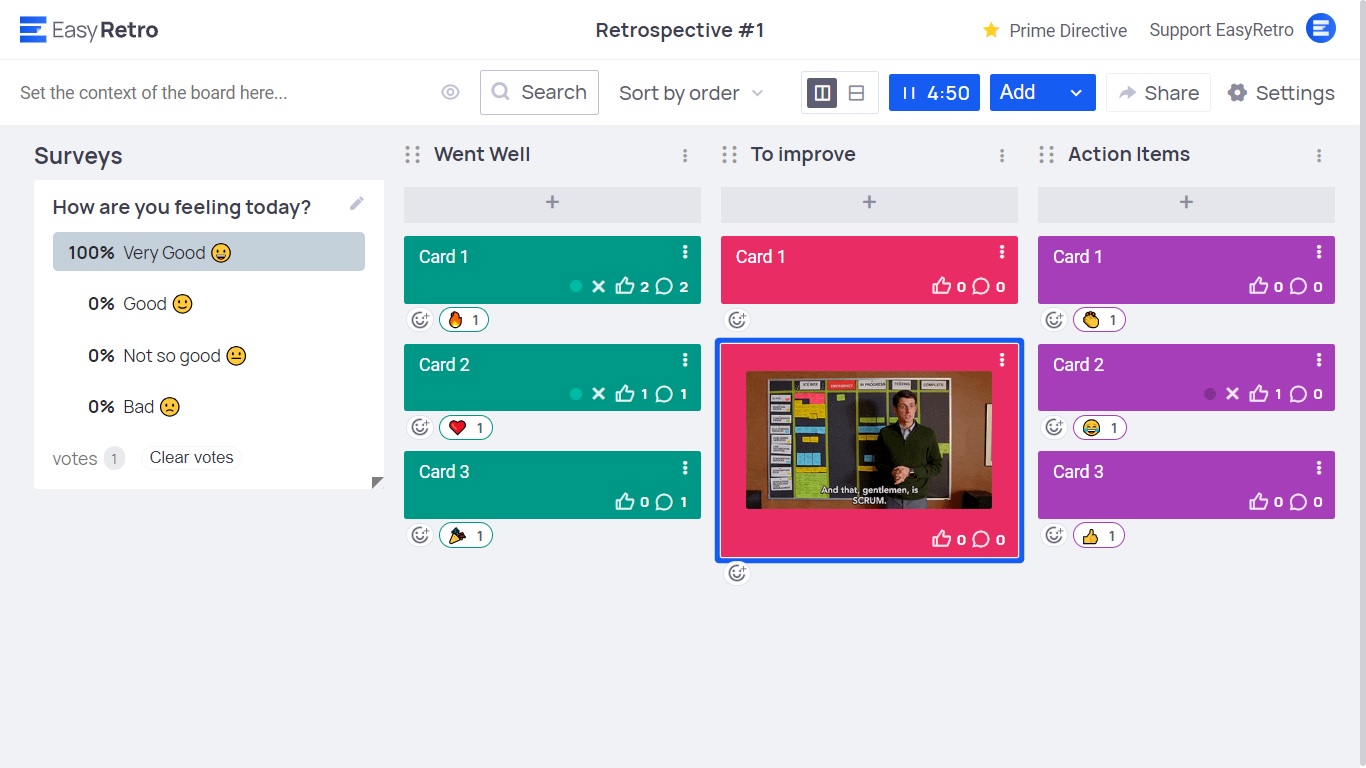
And the interface reflects that focus. Clean to the point of being spartan. Participants join without accounts, voting is obvious, action items export to Jira in a few clicks. If your team lives in the Atlassian ecosystem, the Jira and Confluence integrations make EasyRetro feel like a natural extension of how you already work.
Pros
- Battle-tested since 2015 with a long track record of reliability
- Over 200 pre-built templates covering every retro format imaginable
- Simple, intuitive interface with virtually no learning curve
- Unlimited participants on all plans including free
- Deep Atlassian ecosystem integration (Jira, Confluence, Trello)
Cons
- No AI grouping or card clustering
- Free tier limited to just 1 public board per month
- Retro-only tool with no planning poker or standup support
- Pricing structure is somewhat confusing across tiers
Key Features
200+ Retrospective Templates
This is EasyRetro's strongest selling point. Over 200 pre-built formats organized by category: classic, fun, team-building, project-specific. Each template includes a description of when to use it. For scrum masters running retros every two weeks who want to avoid format fatigue, this variety matters. You can also build custom templates for team-specific formats, and the AI template generator can create new ones from a theme you describe.
Anonymous Feedback and Voting
All boards support anonymous card submissions. This matters for psychological safety. People write more honest feedback when their name isn't attached.
The voting system lets teams prioritize what to discuss, with configurable vote limits per participant. You can set the max votes per column or across the whole board, which gives you flexibility depending on how focused you want the discussion. That limit is a small but smart design choice. Without it, one vocal person can stack votes on their pet issue and dominate the agenda.
Atlassian Integration
The Jira integration lets you create issues directly from retro action items, with assignee and priority mapping. Bulk export to Jira landed in September 2024, which is a big deal for teams with lots of action items. Confluence exports the whole board as a formatted page, which is great for teams maintaining a Confluence wiki. Trello pushes cards to a specified board.
For Atlassian-heavy orgs, these integrations make EasyRetro feel native rather than bolted on.
Facilitator Controls
The facilitator controls when participants can write, vote, and discuss. A built-in timer keeps things on track, with color warnings and sound notifications so nobody misses the cue. Presentation mode lets you reveal columns one at a time, keeping the team focused on a single topic instead of jumping ahead. The hide columns feature (added January 2026) lets admins conceal columns from participants while still seeing them, which is useful for staged facilitation. You can blur or reveal cards to manage the flow, and vote limits are configurable per column or per board.
These controls are simpler than what Parabol offers, but they cover what you actually need for a well-run retro.
AI Board Summaries
EasyRetro added AI-powered board summaries in January 2024. After a retro wraps up, the AI generates a concise summary of the key themes and takeaways. It's not going to replace a thoughtful facilitator debrief, but it's useful for quick documentation and sharing outcomes with stakeholders who weren't in the room.
What it doesn't do: AI grouping or card clustering. You're still manually dragging cards together to merge related feedback.
No AI grouping means you're manually clustering cards every session. For retros with 50+ cards, that adds real time. If AI grouping matters, check Kollabe.
For teams running large retros with 50+ cards, that manual grouping adds real time. If AI grouping matters to you, Kollabe handles that.
Export and Reporting
Boards export as PDF, CSV, PNG, Excel, DOCX, or directly to connected tools like Jira and Confluence. The PNG export even preserves GIF animations, which is a quirky but thoughtful detail. Exports include all cards, votes, and action items. Good enough for reporting retro outcomes to leadership or keeping records.
But there's no cross-board analytics or trend reporting. The analytics dashboard on paid plans shows basic retro history and action item tracking, but you won't find sentiment trends, participation rates, or velocity data. If you want that, TeamRetro is the tool to look at.
Pricing
EasyRetro uses flat-rate pricing, not per-user. Every tier lets unlimited participants join boards, which is increasingly rare in this space. As of early 2026:
Free gives you 1 public board per month with just 1 board total on your dashboard, 1 survey per month, unlimited participants, and access to all 200+ templates. Enough to try the tool, not enough for regular use. That single-board limit is stingy compared to GoRetro, which gives you 5 boards on the free plan.
Team ($38/month) unlocks 5 boards per month, 1 team, unlimited team members, unlimited surveys, integrations, exports, and analytics. This is the plan most individual scrum masters or small teams will land on.
Business ($60/month) bumps you to 15 boards per month and 3 teams. Same feature set as Team, just higher limits. Makes sense for departments with a few squads.
Enterprise ($90/month) gives you 30 boards per month, 6 teams, and adds SAML SSO with support for Okta, Azure/Microsoft Entra, Google Workspace, and PingOne. For larger orgs, custom Enterprise plans offer up to unlimited boards and teams.
Every EasyRetro plan allows unlimited participants. A 20-person team pays the same $38/month as a 5-person team.
The flat-rate model is a real advantage. That math works out well for bigger groups. But the board-per-month limits on lower tiers can bite if you run frequent retros across multiple teams.
Ease of Use
EasyRetro might be the easiest retro tool to pick up. Create a board, share the link, start collecting feedback. 60 seconds, tops. The interface strips away everything non-essential, leaving you with columns, cards, and votes. There are no separate meeting types or configuration screens to wade through, and you won't need an onboarding wizard because there's nothing to onboard.
That simplicity cuts both ways. Experienced facilitators who want AI grouping, cross-team analytics, or support for other ceremonies will hit the ceiling fast. But for the scrum master who needs a solid digital board for a bi-weekly retro, the simplicity is the point. The tool loads fast, handles large groups without lag, and the unlimited participant support means you never bump into a headcount wall during a bigger team event.
Who Is It Best For?
EasyRetro is for teams that want a proven retro platform without the complexity of multi-ceremony tools. It fits especially well in Atlassian-centric organizations where Jira and Confluence are the primary workflow tools. Those integrations are mature and well-tested. Pushing action items from a retro straight into a Jira sprint works exactly how you'd expect.
It's also a good pick for scrum masters who facilitate retros across multiple teams and want a big template library to keep sessions fresh. 200+ templates gives you real variety for avoiding retro fatigue.
EasyRetro is retro-only. No planning poker, no standups. If you need multiple ceremonies, you'll need a second tool or a platform like Kollabe.
But if you need planning poker or standups too, you'll need a separate tool or a broader platform like Kollabe or Parabol. And if you want AI-powered grouping and card clustering, EasyRetro doesn't have it -- though the AI board summaries are useful for quick recaps after a session. For a direct comparison, see our Kollabe vs EasyRetro guide.
The Verdict
EasyRetro has earned its reputation through nearly a decade of reliable service. The rebrand from FunRetro didn't change the core product: keep it simple, keep it focused, do retros well. For teams whose needs start and end with retrospectives, it's still an excellent choice. The template library alone is worth the price.
The gaps are real though. AI summaries landed in 2024, which helps with documentation, but there's still no AI grouping -- so you're manually clustering cards during every session. No poker or standups means you'll need other tools for those ceremonies. And the free tier's one-board limit is tight compared to what competitors offer.
None of that is a dealbreaker for teams that value simplicity and reliability. But it's worth weighing against more capable alternatives. If you're a scrum master in the Atlassian ecosystem who runs straightforward retros and wants something that just works, EasyRetro is a safe bet. If you want AI grouping and multi-ceremony support, explore Kollabe or Parabol instead.