

Overview
Most retro tools are built for the team in the room. ScatterSpoke is built for the person watching trends across every room.
That distinction shapes everything about the product. If you are an engineering director, VP, or agile coach responsible for multiple teams, you have a problem that tools like Retrium or Neatro were never designed to solve: how do you understand what is happening across ten or fifty teams without sitting in every meeting?
ScatterSpoke answers that with AI-powered feedback analysis, cross-team rollups, and executive dashboards. More recently, they added an AI standup copilot that tries to eliminate wasteful daily meetings altogether. The platform also supports blameless post-mortems and developer experience surveys, so feedback from multiple ceremony types feeds into the same analytics layer.
It is a small company. Founded in 2019 by Colleen Johnson and John Samuelson in Denver, around a dozen people, backed by TinySeed and Atlassian Ventures ($550K total). Dan Wyks came on as CEO in 2025. The Atlassian Ventures backing matters because the Jira integration gets real attention as a result.
Pros
- Strongest AI and analytics capabilities among dedicated retro tools
- Cross-team rollups give leaders visibility without micromanaging
- Stand Up Copilot replaces wasteful daily meetings with AI-driven async updates
- SOC 2 Type II certified on Business plan and above
- 45-day free trial — longest in the category
Cons
- Massive price jump from Starter ($30/mo) to Business ($300/mo)
- Free plan is very limited — 10 users, 1 team, 90-day history
- No mobile support at all — not even responsive web
- No planning poker, health checks, or sprint planning features
- Tiny user base and zero G2 reviews — hard to find peer feedback
Key Features
AI-Powered Feedback Analysis
ScatterSpoke calls it the "Retrospective Copilot." The AI analyzes feedback across teams and over time, surfacing recurring topics, sentiment shifts, and emerging concerns without anyone having to manually read through hundreds of sticky notes.
This goes beyond keyword counting. The analysis groups related feedback even when teams use different language for the same problem. Three teams struggling with deployment processes might call it "slow releases," "CI/CD pain," and "deploy friction." ScatterSpoke connects those dots and quantifies the impact.
MURAL has general AI analysis, but it does not do cross-team pattern recognition at this level. Most dedicated retro tools like Neatro have no AI at all.
Stand Up Copilot
The Stand Up Copilot runs async standups through Slack, Microsoft Teams, or email. Instead of rigid standup-bot templates, the AI generates contextually relevant questions and summarizes responses, flagging only the items that need a real conversation.
The idea: meet when it matters, not every day. The copilot tracks coding activity and work progress, then tells you when something deserves attention versus when the team can skip the meeting.
It is not as mature as dedicated standup tools like Geekbot or DailyBot. But if you are already using ScatterSpoke for retros, having standups feed the same analytics pipeline fills in gaps that retro data alone cannot.
Cross-Team Analytics and Dashboards
The analytics are the reason you pay $300/month. Aggregated data across all your teams: common themes, sentiment trends, action item completion rates, all in dashboards designed for leadership.
The "Top Issues" view tries to quantify impact. Instead of just "teams are unhappy about deployments," it connects that frustration to cost and velocity numbers. You can drill into specific teams or time periods without opening individual retro boards.
Useful for justifying retrospectives to stakeholders who wonder whether "all those meetings" produce anything. Hard to argue with data showing that identified issues are actually getting addressed.
Continuous Feedback Collection
ScatterSpoke does not wait for the biweekly retro. It collects input through Slack and Microsoft Teams on an ongoing basis. You configure schedules for when and what to ask, and feedback trickles in between sessions.
The benefit is obvious: people remember what frustrated them on Tuesday better on Tuesday than they do the following Thursday. And dropping a quick note in Slack gets input from people who never speak up in live meetings.
Retrospective Features
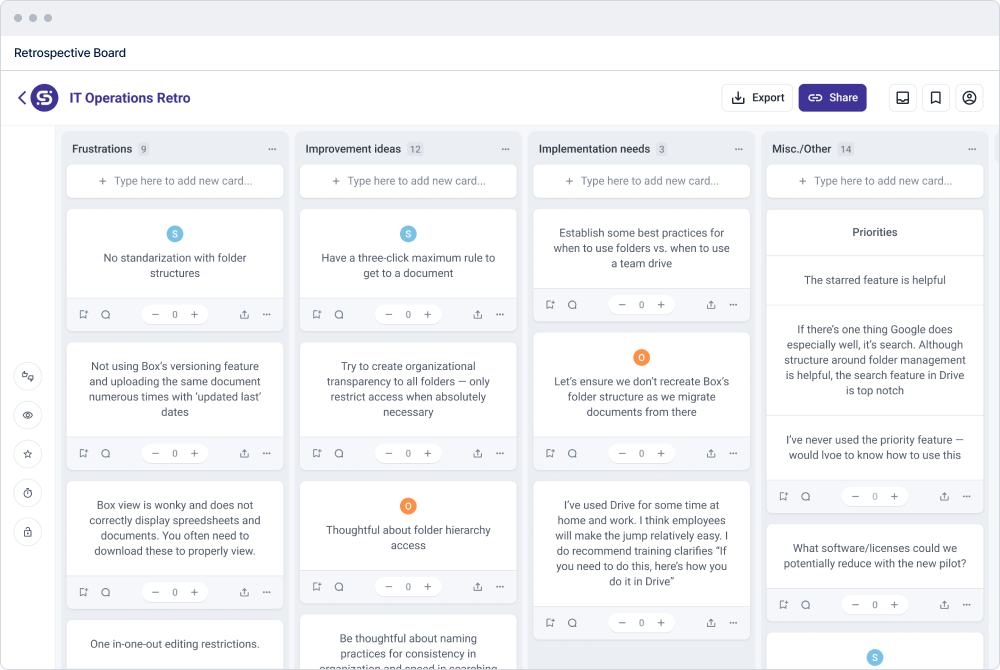
At the team level, ScatterSpoke covers the basics well. Anonymous cards, voting with a private voting option, a built-in timer the facilitator can set to any duration, and 19-20 retro formats including pre-mortem, rose/thorn/bud, and peaks and valleys. You can start with a blank board too.
Action items can be created during retros, assigned to owners, and exported to Jira or Trello. PDF, CSV, and Excel exports are all available.
Where it falls short compared to dedicated facilitation tools: there is no automated card grouping (you do that manually), no presentation mode, and you cannot add or remove steps from existing templates. The retro experience is functional but unremarkable. The analytics layer on top is what sets it apart.
Integrations
Jira is the deepest integration. ScatterSpoke has two separate apps on the Atlassian Marketplace: one for pushing action items and cards to your Jira backlog, another for pulling metrics. GitHub and Bitbucket connect for pulling coding activity into the AI insights engine. Slack and Microsoft Teams handle feedback collection, standup responses, and notifications.
The integration list is short compared to Miro's 160+ connections. No Azure DevOps. No Linear. No Confluence. If your team's workflow depends on any of those, that is a dealbreaker.
The Starter plan caps you at 2 integrations. You need the $300/month Business plan for unlimited.
Pricing
The pricing structure has a canyon in the middle:
- Free: 1 team, 10 users, unlimited retros, 20 AI reports/month, 90-day history. Enough to evaluate, not enough to rely on.
- Starter: $30/month. 5 teams, 100 users, 100 AI reports/month, 2 integrations, 6-month history.
- Business: $300/month. Unlimited everything. Cross-team analytics, executive dashboards, full AI, SOC 2 reports, priority support.
- Enterprise: Custom pricing. SSO/SCIM, custom AI prompts, custom domain, 99.9% uptime SLA.
The $30 to $300 jump is steep. Everything that makes ScatterSpoke interesting — cross-team rollups, executive dashboards, full AI — lives behind the Business tier.
That $30 to $300 jump kills a lot of evaluations. Everything that makes ScatterSpoke interesting, the cross-team rollups, the executive dashboards, the full AI analysis, lives behind the Business tier. The Starter plan is a perfectly adequate but unremarkable retro tool. Business is where the actual product is.
Annual billing gets you two months free, bringing Business to roughly $250/month.
ScatterSpoke offers a 45-day free trial on paid plans — the longest in the category. Use it. The analytics have a real learning curve.
They also offer a 45-day free trial on paid plans, longer than anyone else in the category. You will want that extra time given the learning curve around the analytics.
One thing to know: older competitor comparison pages reference a per-user pricing model ($6/user/month). ScatterSpoke restructured to flat monthly tiers sometime in 2024-2025.
Security
ScatterSpoke is SOC 2 Type II certified, with reports available on the Business plan and custom reports on Enterprise. SSO and SCIM provisioning are Enterprise-only.
That puts ScatterSpoke ahead of several competitors. Parabol lists SOC 2 as "in progress." Neatro does not mention it. If security review is part of your procurement process, this is a real differentiator.
The rest of their security documentation is thin. GDPR compliance is not publicly addressed, and encryption specifics are nowhere to be found. The site says "Data Security & Privacy" but does not explain what that means in practice. If your compliance team needs details beyond the SOC 2 report, expect to go through sales.
Ease of Use
Running a retro at the individual team level is straightforward. Pick a template, collect feedback, discuss, create action items. The interface is clean. Nothing flashy.
The analytics and dashboard features take more time to learn. Configuring cross-team views, understanding what the AI is surfacing, figuring out how to act on the data. Budget a few sessions to get comfortable if you are the one setting up the analytics layer.
No mobile support at all. Not a native app, not even a responsive web experience. Feedback collection from phones is a non-starter.
One notable gap: no mobile support. Not a native app, not even a responsive mobile web experience. If your team members want to drop feedback from their phone between meetings, they are out of luck. That limits the "continuous feedback" pitch somewhat.
Who Is It Best For?
ScatterSpoke hits its stride with a specific audience:
- Engineering directors and VPs overseeing multiple Scrum teams
- Agile coaches working across an organization who need data, not anecdotes
- Leaders who want to connect retro feedback to developer experience metrics
- Organizations large enough to benefit from cross-team pattern recognition
- Teams that want async standups and retros feeding into the same analytics engine
For a single team running its own retros, ScatterSpoke is overkill. That team would get more from Retrium for guided facilitation, Neatro for something lighter, or Parabol for a free all-in-one option.
The Verdict
No other dedicated retro tool does what ScatterSpoke does at the analytics and cross-team level. The Stand Up Copilot adds a second ceremony type feeding the same engine, and the SOC 2 certification gives it credibility that several bigger-name competitors still lack.
But the pricing cliff is real. The interesting features live at $300/month. Retrium charges $39/team/month. Parabol starts at $8/user/month. The free plan's 10-user cap and 90-day history make it hard to even evaluate the product properly before committing.
If your organization runs enough teams that cross-team analytics would change how you operate, and the budget is there, ScatterSpoke is worth the trial. Everyone else will do fine with simpler tools.