
Overview
Retrium is the retro tool that takes facilitation seriously. Where most platforms give you a blank board and leave the rest up to you, Retrium walks your team through a structured workflow: brainstorming, grouping, voting, action items. Each phase has clear instructions and time boundaries. Even a first-time facilitator can run a decent session.
Adobe, Amazon, and Siemens all use it. That enterprise pedigree shows up in the feature set and the price tag. Retrium is not trying to be cheap. It is trying to be the tool that makes retrospectives actually produce results.
If you have sat through retros that devolved into silence or circular venting, Retrium's guided approach addresses that problem head-on. But if you want a free tool, or something that does more than just retros, this is not it.
Pros
- Per-team-room pricing with unlimited users keeps costs predictable
- Excellent guided facilitation walks teams through each retro phase
- Strong enterprise credentials — used by Adobe, Amazon, and Siemens
- Async support lets distributed teams contribute on their own schedule
Cons
- No free plan — only a 30-day trial to evaluate
- $39/month starting price is higher than most competitors
- Retro-only tool with no broader agile workflow capabilities
- No AI-powered features for feedback analysis or action suggestions
Key Features
Guided Facilitation Workflow
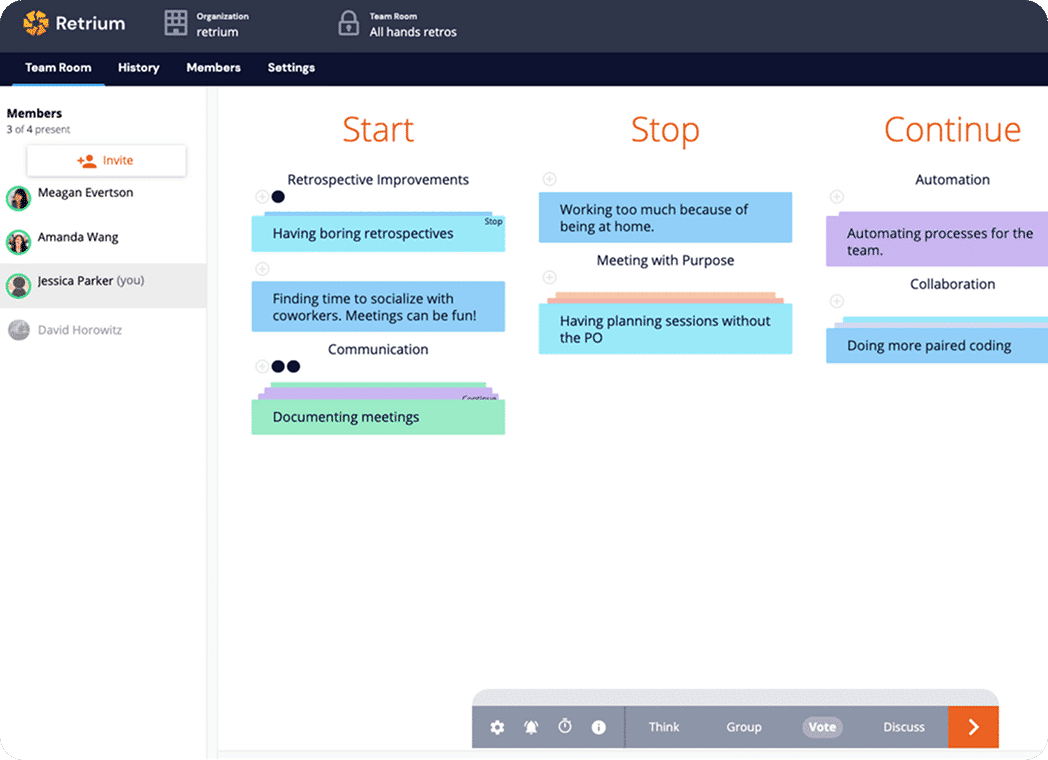
This is the reason to use Retrium. The platform breaks each retrospective into phases: brainstorming, grouping similar ideas, voting on priorities, defining action items. The facilitator controls the pace, and the tool tells everyone what happens next.
Guided facilitation is Retrium's standout feature. Even a first-time scrum master can run a productive retro without preparation.
It works. Teams that struggled with freeform retros often see a real improvement in participation and output quality. The format is especially useful for newer Scrum Masters who have not yet developed their own facilitation instincts, or for teams where one or two loud voices tend to dominate.
Template Library
Retrium ships with 11+ built-in techniques: Start/Stop/Continue, Mad/Sad/Glad, Lean Coffee, 4Ls, Sailboat, Starfish, Fishbone, SWOT, WRAP, What Went Well, and Team Radar. Each one comes with facilitation prompts specific to that format, not just column headers. You can also build custom templates from scratch with your own column names and save them for reuse.
The selection is smaller than Neatro at 70+ or Metro Retro at 115+. Retrium made a deliberate choice to go with fewer, better templates rather than padding the number. Every format here is based on published agile coaching methodologies and has real facilitation guidance baked in.
Anonymous Feedback
Team members can submit feedback without their names attached. Standard for retro tools at this point, and Retrium handles it well. Anonymous mode applies during brainstorming, which is where it matters most for getting honest input on difficult topics.
Team Radar Health Checks
Beyond individual retros, Team Radar lets you track team sentiment across multiple dimensions over time. You can see whether action items are actually moving the needle, and spot patterns before they become problems.
It is not as sophisticated as the cross-team analytics in ScatterSpoke. But for a single team tracking its own health over months, it adds real depth to what is otherwise a retro-only tool.
Async and Real-Time Support
Distributed teams can use async mode to let people contribute on their own schedule before the live discussion. Practical for teams spanning time zones. People can submit their thoughts when it is convenient rather than trying to remember everything during a single 60-minute window.
Integrations
Action items push directly into Jira Cloud, and there is a full Slack app that goes beyond simple notifications. The Slack integration lets team members join retros from Slack, see real-time progress updates during sessions, and update action item status without leaving the channel. Every Monday, it sends action item summaries to subscribed channels. That weekly nudge is a small thing, but it is the kind of thing that actually gets action items closed instead of forgotten by the next sprint.
Retrium also exports action items to GitHub, Trello, ClickUp, and Asana, though those integrations are lighter than the Jira and Slack connections. No Confluence, Linear, or Azure DevOps support.
Pricing
No free plan. You get a 30-day trial, then you're paying. No refunds of any kind.
No free plan. That is the first thing to know. You get a 30-day trial, and then you are paying.
- Team: $39/month per team room. Unlimited users, all retro techniques, Jira Cloud integration. Credit card required.
- Business: $59/month per team room ($715/year annually). Adds SAML SSO, priority support, volume discounts, SOC audit access, and annual invoicing.
- Enterprise: Contact sales for 25+ teams. Dedicated CSM, personalized onboarding, custom contracts, unlimited training hours.
Per-team-room pricing: a 15-person team pays $39/month total, not $39 per head. That makes Retrium surprisingly affordable for larger teams.
The per-team-room model is genuinely different from per-user pricing and worth understanding. That makes Retrium surprisingly affordable for larger teams, even though the sticker price looks high next to Neatro at around $29/month or Metro Retro at $4/user.
The math shifts for organizations with many small teams. Five rooms at $39 each is $195/month. That adds up. No refunds of any kind, either, so make the most of that 30-day trial.
Ease of Use
Retrium is easy to pick up precisely because the guided workflow removes the guesswork. Facilitators do not need to plan how to run the retro. They pick a format, and the tool handles the structure.
The interface is clean and purposeful. Not exciting to look at. It lacks the playful canvas feel of Metro Retro or the whiteboard flexibility of Miro, but that restraint keeps people focused. Nothing extraneous to click on or get lost in.
Participants can join with minimal onboarding. Most teams run a productive retro on their first try.
Who Is It Best For?
Retrium is built for Scrum teams that want structure and accountability in their retros. Good fit if:
- Your team's unstructured retros tend to go off the rails
- You have a newer Scrum Master who would benefit from guided facilitation
- Your organization needs enterprise security and compliance credentials
- You have distributed teams across time zones who need async support
- You prefer per-team-room pricing over per-user costs
Less ideal if you are a startup watching every dollar, a solo practitioner, or a team that wants more than retrospectives from a single tool. Teams looking for AI-powered insights should look at ScatterSpoke instead.
The Verdict
Retrium does one thing and does it well: structured, guided retrospectives. The facilitation workflow is the best in the category, and the per-team-room pricing is a relief for larger teams sick of per-seat costs piling up.
The trade-offs are real. No free plan means you cannot kick the tires casually. $39/month is steep compared to alternatives. And the retro-only scope means you will need separate tools for everything else in your agile workflow. If guided facilitation is what you need and you are willing to pay for quality, Retrium delivers. For everyone else, there are more flexible and affordable options out there.