

Quick Verdict
These tools are aiming at different jobs, and the comparison only makes sense once you see that.
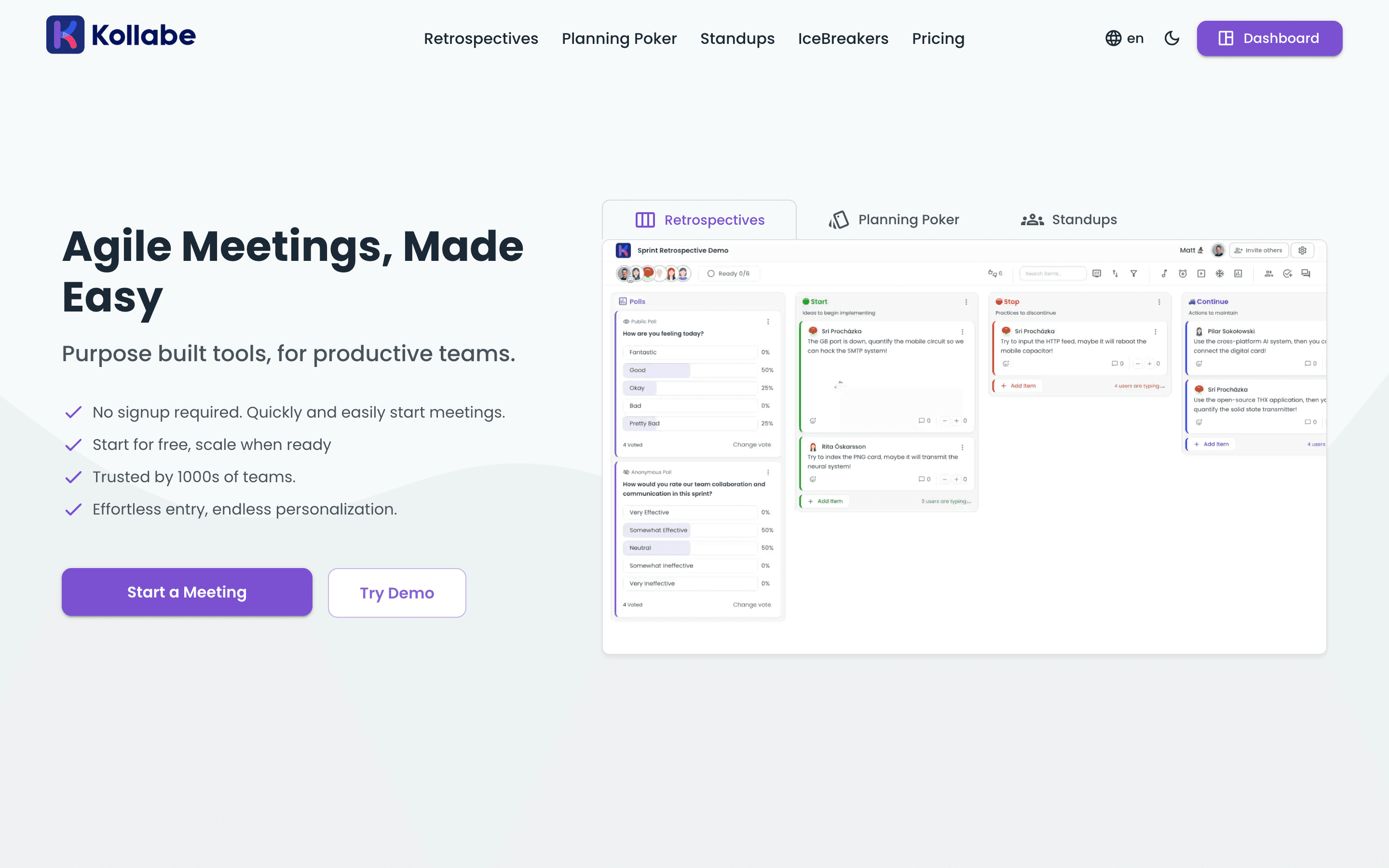
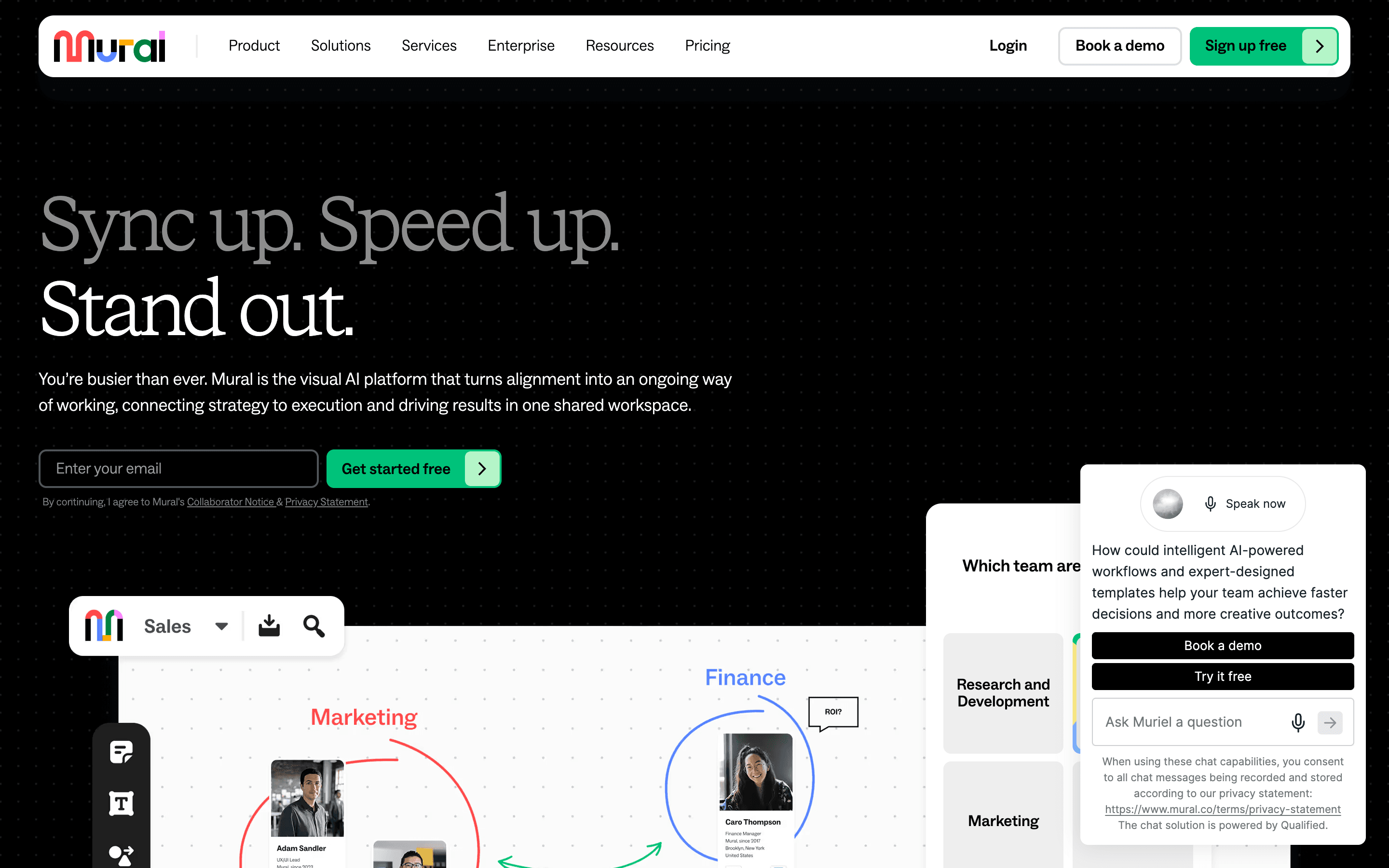
Kollabe is a dedicated agile ceremonies toolkit. Retros, planning poker, async standups, icebreakers, all in one place, with AI that actually facilitates. MURAL is an enterprise visual collaboration platform, a near-infinite whiteboard that happens to ship with retro templates. It's used by 80% of the Fortune 100 for workshops of every kind.
If your week is retros, estimation, and standups, Kollabe does that better and costs less. If you run big facilitated workshops across departments and need SOC 2, native apps, and Slack and Teams baked in, MURAL is built for that scale and Kollabe simply isn't.
So this isn't "which retro tool is better." It's "do you want a retro tool or a whiteboard."
Feature Comparison
Both cover the retro fundamentals. Templates, voting, timers, AI grouping, AI summaries, sentiment analysis. On paper they overlap more than you'd expect.
The split shows up in workflow. Kollabe runs a guided retro through write, group, vote, and discuss phases, with a real action item tracker underneath. You assign owners, set due dates, and carry items between sprints. MURAL has no enforced phase progression. The facilitator builds the flow by hand using Outline and Hide & Reveal, and "action items" are sticky notes with color tags. There's no native tracker with due dates or status. You export to Jira and manage them there.
Then there's everything Kollabe does that MURAL doesn't. Planning poker with Jira, GitHub, Azure DevOps, and Linear ticket import, plus auto-sync of the winning estimate back to story points. Async daily standups in a persistent room with AI digests. MURAL has neither. You can draw a poker layout on the canvas, but there's no voting deck, no card reveal, no calculation.
MURAL's facilitation suite is genuinely strong for live workshops. Summon pulls everyone to your view, Take Control guides their navigation, Private Mode hides contributions to kill groupthink, and Facilitator Lock stops accidental edits. For a 40-person cross-team session, that toolkit beats anything in a dedicated retro app.
One honest caveat on anonymity. Kollabe has true anonymous sticky notes you can toggle per session. MURAL's Private Mode only hides who's writing what in real time. Once you reveal, contributions are attributed. For psychologically safe retros, that difference matters.
Template count tips to Kollabe too: roughly 1,000 themed templates plus an AI generator, against MURAL's 100-plus across all use cases, of which maybe 8 are retro-specific.
Pricing Comparison
This is where the gap is hardest to ignore, because the two tools bill on completely different models.

Kollabe
Flat per team, retros, poker, and standups included
- Unlimited participants and history
- All AI features included
- All integrations included
- Free tier (up to 10 participants)

MURAL
Team+ plan, billed annually. AI features start here
- Unlimited murals and visitors
- AI grouping, summaries, sentiment
- Business plan $17.99/user for SSO
- Free tier capped at 3 active murals
The per-seat math is what gets you. MURAL's Team+ looks cheap at $9.99, but it's per user per month on annual billing. A 10-person team is $100/month, or $1,200 a year. Kollabe is $29/month flat for that same team, poker and standups included, no per-head cost.
Push it to a 20-person squad and MURAL's Team+ is roughly $200/month. Kollabe is still $29. And if you need SSO from MURAL, you're on the Business plan at $17.99/user, annual only.
MURAL's free tier is also tighter than it sounds: 3 active murals, and no AI at all. Kollabe's free tier gives you actual retros for up to 10 people. Kollabe's catch is the per-Space model. Each team is its own $29 subscription, so an org with five small teams pays $145/month. That still undercuts MURAL per-user pricing at almost any team size, but it's worth knowing if you're spinning up lots of separate Spaces.
Ease of Use
For someone whose job is running a retro, Kollabe has less to learn. Pick a template, the phases guide the session, AI groups the notes, and you get a summary. The tool is shaped like the ceremony.
MURAL is a blank canvas, which is its strength and its tax. Endless flexibility, but you're responsible for structure. New facilitators routinely hit the "everyone's lost on a giant board" problem, and the fix is learning the facilitation controls. Once a power facilitator knows Outline, Summon, and Hide & Reveal, MURAL runs a tight room. Getting there takes reps.
Both are browser-based with nothing to install to start. MURAL pulls ahead on reach, though: native iOS, Android, Windows, and macOS apps. Kollabe is web-only, responsive on mobile but with no native app.
Integrations
MURAL has the wider footprint by a wide margin. 40-plus integrations, including two-way sync with Jira, Azure DevOps, Asana, Salesforce, Rally, and Microsoft Planner, plus Microsoft Teams, Slack notifications, Zoom, Webex, Google Workspace, and Zapier to 5,000 more apps. For an org standardized on Microsoft 365, the Teams integration alone is a strong reason to pick it.
Kollabe connects to fewer tools but goes deeper on the dev-workflow ones that matter for ceremonies: Jira, GitHub, Azure DevOps, Linear, and Confluence. The poker ticket import and estimate auto-sync are the standout, and MURAL has no equivalent because it has no poker.
If your retro outcomes need to land in Slack or Microsoft Teams automatically, MURAL handles it and Kollabe does not. Kollabe has no Slack or Teams integration at all. For distributed teams that live in chat, that's a real gap worth weighing before you commit.
One more for MURAL: Linear. Kollabe added Linear in January 2026, but MURAL still has no Linear integration, so Linear shops should check which side of that matters more for their workflow.
AI and Automation
Both ship the same core AI trio: grouping, summaries, sentiment. MURAL calls them Cluster, Summarize, and Classify, all on Team+ and above, with extra reach through Microsoft 365 Copilot. Kollabe matches each and adds custom AI instructions, so you can tell the summary to focus on deployment pain or team morale specifically.
The real difference is coverage. Kollabe's AI runs across all three ceremonies. Custom retro summaries, an AI template generator, sentiment trends, and standup digests on daily, weekly, or fortnightly cadences. MURAL's AI is canvas-wide and powerful for general workshops, but there's no poker or standup for it to touch.
Neither is reinventing facilitation with AI. For retro-and-estimation work, Kollabe's AI reaches into more of the job. For broad visual collaboration, MURAL's AI works anywhere on the board.
Who Should Choose Which?
Choose Kollabe if…
- Your week is retros, planning poker, and standups, not general whiteboarding
- You want ticket import and auto estimate sync for poker sessions
- You need true anonymous sticky notes and a real action item tracker
- Flat $29/month per team crushes per-user pricing at almost any size
- You want fully async retros and standups out of the box
Choose MURAL if…
- You run large facilitated workshops across many departments
- SOC 2, ISO 27001, audit logs, and data residency are hard requirements
- Your org lives in Microsoft Teams or needs Slack notifications
- You need native iOS, Android, Windows, and macOS apps
- You want one infinite canvas for retros, mapping, design, and planning
Final Recommendation
For an agile team that runs ceremonies, Kollabe is the better buy and it isn't close on value. One $29/month subscription covers retros, poker, and standups with AI across all three, a real action item tracker, true anonymous mode, and ticket sync MURAL can't match. You'd spend several times that on MURAL per-user pricing for a tool that has no poker and no standups.
MURAL earns its price for a different buyer. If you're an enterprise running facilitated workshops at scale, and SOC 2, native apps, and deep Microsoft integration are non-negotiable, MURAL is built for exactly that, and Kollabe's gaps there are real. Kollabe has no SOC 2, no native apps, and no Slack or Teams. For a security-led enterprise procurement, those are dealbreakers.
So choose by job. If you came here to run better retros, Kollabe is purpose-built for it. If you need an org-wide whiteboard that occasionally hosts a retro, MURAL is the serious enterprise pick, and the Miro vs MURAL comparison is worth a look if you're shopping whiteboards rather than retro tools.