

Quick Verdict
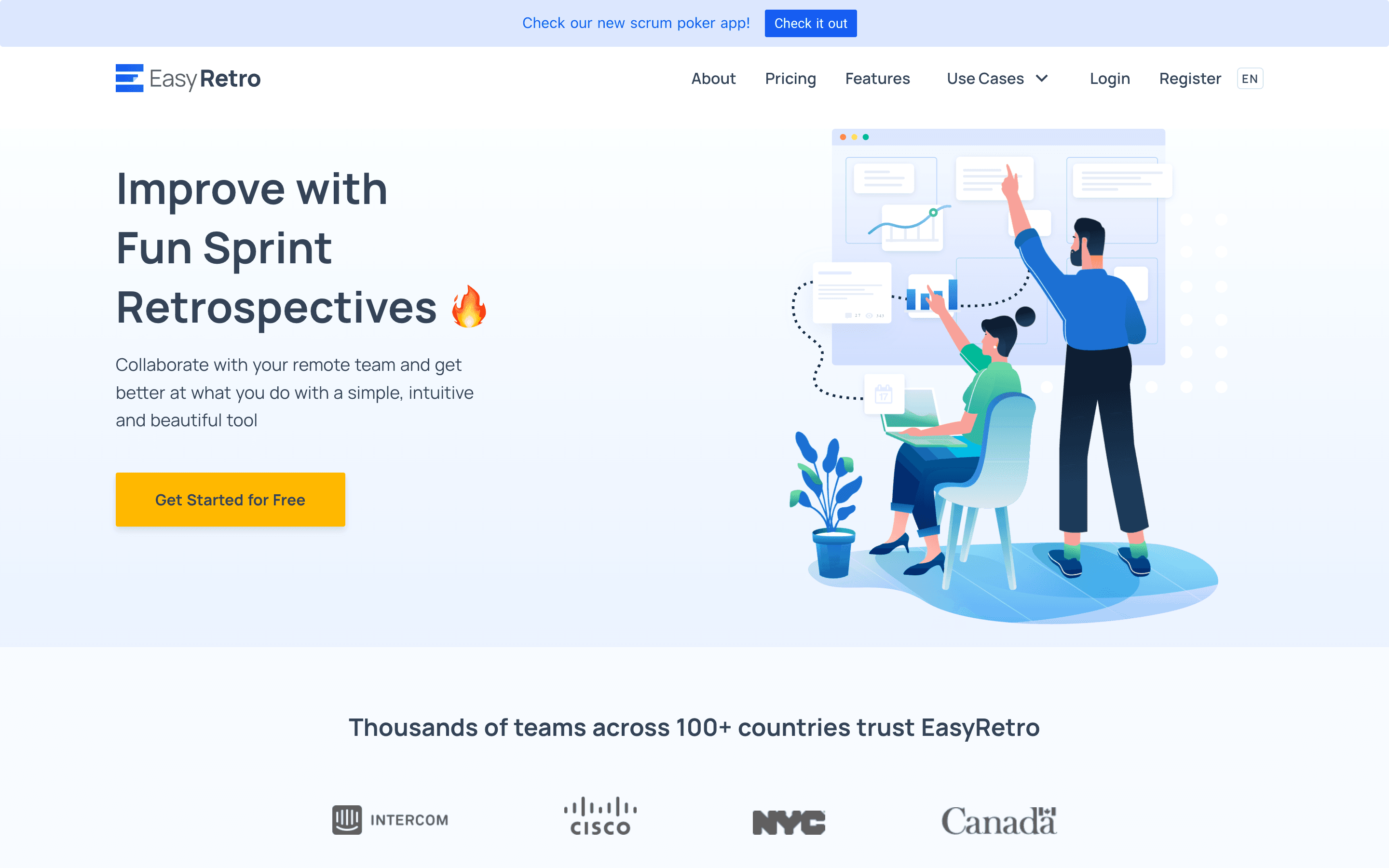
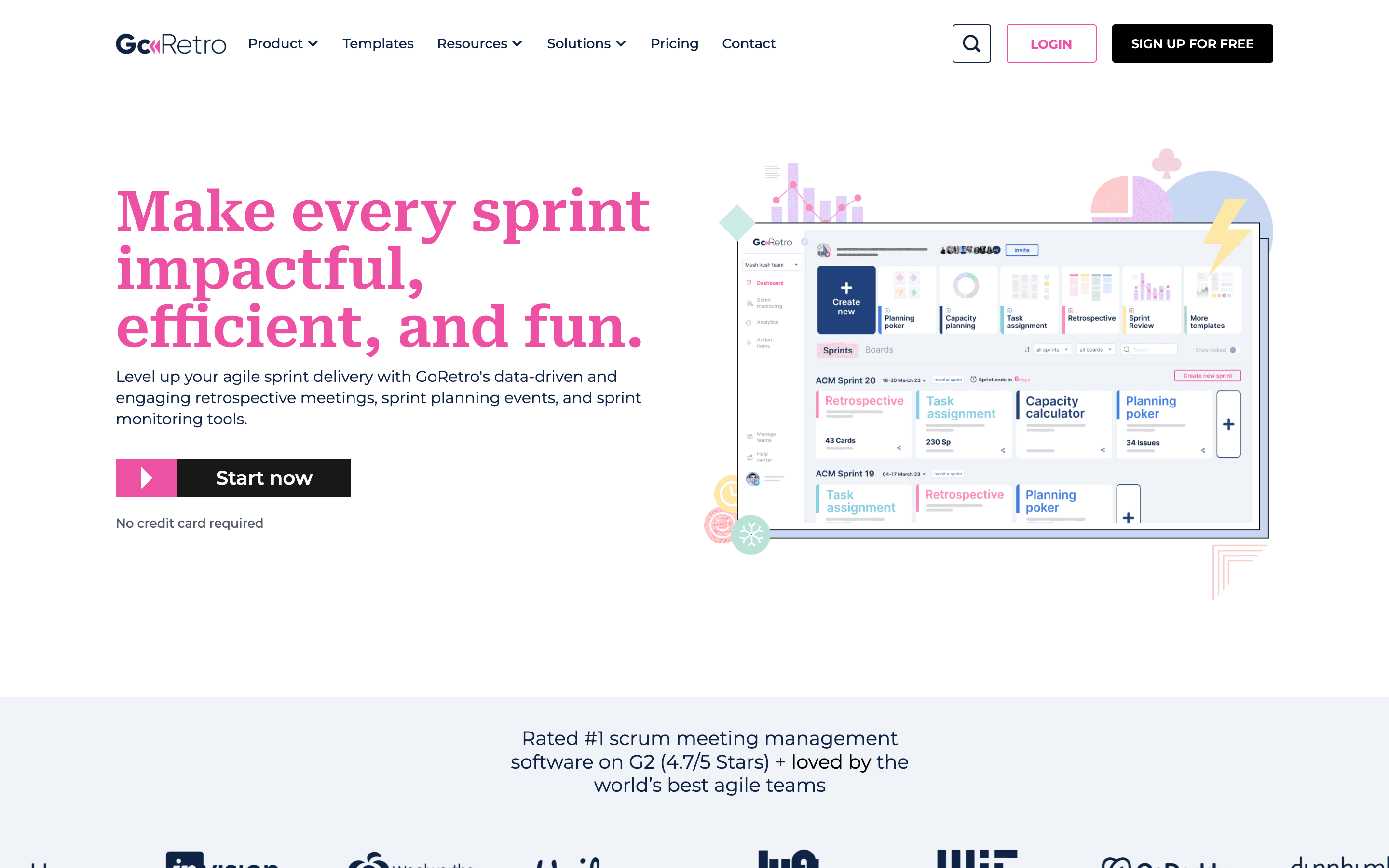
EasyRetro does one thing well: retrospective boards. GoRetro tries to do more (planning poker, sprint monitoring, capacity planning) but spreads itself thinner.
For teams that need a reliable retro tool with a big template library, working Jira and Slack integrations, and AI summaries, EasyRetro is the better pick. It's been running since 2015, has facilitated over a million retros, and still ships regular updates.
GoRetro earns its spot if your team needs planning poker bundled with retros and doesn't want to pay for a separate estimation tool. The Jira integration for importing backlogs and syncing estimates back is useful. But GoRetro's public changelog went quiet after May 2023, its integration list is short, and the AI story is unclear at best.
Feature Comparison
The retro basics overlap: anonymous mode, templates, voting, timers, action items with owners and due dates. Both let participants join without accounts. Both work in a browser with no native apps.
Past the basics, EasyRetro pulls ahead. The template library alone is a different league: 200+ formats in multiple languages compared to GoRetro's 34. EasyRetro has confirmed AI board summaries, an AI template generator, card drawing, emoji reactions, dark mode, keyboard shortcuts, password-protected boards, card merging, and board embedding. Most of those don't exist in GoRetro. Export options tell a similar story. EasyRetro outputs to PDF, CSV, PNG, XLSX, DOCX, and Clipboard, plus direct Confluence export. GoRetro does PDF, CSV, and clipboard, and only on premium plans.
Where GoRetro wins is planning poker. On the Sprint Pro plan ($49/month), you get custom decks, Jira backlog import, and estimate syncing back to Jira. If your team currently pays for a separate poker tool alongside retros, GoRetro rolls both into one bill. It also has facilitated icebreakers with random questions and a happiness index that tracks team mood on a 1-5 scale across sprints.
GoRetro markets itself as a sprint management platform, not just a retro tool. But its sprint monitoring and capacity planning features require the $49/month Sprint Pro tier. At the $29/month Premium tier where most teams would start, GoRetro is basically a retro board with action items, similar to EasyRetro but with fewer templates, fewer exports, and a smaller integration list.
EasyRetro added a hide column feature in January 2026, card drawing in August 2025, and enhanced timers with color warnings and sound alerts. GoRetro's last documented update was May 2023. That gap matters if you care about ongoing development.
Pricing Comparison
Both use flat-rate team pricing rather than per-user billing. GoRetro is cheaper at entry level, but EasyRetro gives you more at each tier.

EasyRetro
Team plan — flat rate
- 5 boards/month, 1 team
- Free tier available (1 public board)
- AI summaries, 6 export formats, all integrations
- SAML SSO on enterprise plans only

GoRetro
Premium — billed annually
- Unlimited boards, 1 team
- Free tier: 5 public boards
- Planning poker requires $49/mo Sprint Pro
- SAML SSO on Organization (custom) plan only
EasyRetro's free tier barely functions: 1 public board, 1 board on your dashboard, archived boards count against the limit. GoRetro's free plan is slightly more generous with 5 public boards but strips out exports and advanced action items.
At the paid level, GoRetro's Premium at $29/month beats EasyRetro's Team at $38/month by $9/month and includes unlimited boards. But the moment you want planning poker, you're at $49/month on Sprint Pro. A team that only needs retros saves $9/month with GoRetro. A team that wants retros plus poker pays $11/month more than EasyRetro for the bundle.
Neither tool prices per user, which means both are bargains for larger teams. A 20-person squad pays the same as a 5-person team.
Ease of Use
EasyRetro is simpler and more polished. No account required for participants. Dark mode, keyboard shortcuts, card colors, a drawing tool, GIF support. A decade of small refinements adds up. The presentation mode reveals columns one at a time to keep discussions focused, and multi-language support covers eight languages.
GoRetro is straightforward too, but the interface hasn't seen visible updates since mid-2023. The board creation flow works fine. Facilitator controls (hide cards, disable voting, limit votes) cover the essentials. But there's no dark mode, no keyboard shortcuts, and no evidence of mobile optimization.
Both tools are easy to learn in a single session. If you've used any sticky-note retro tool before, either one will feel familiar.
Integrations
EasyRetro connects to Jira Cloud, Confluence, Trello, Slack (notifications), and Microsoft Teams (board embedding). Action items export to Jira and Trello. Boards export to Confluence pages. It's Atlassian-heavy, but that's where most teams live.
GoRetro connects to Jira and Slack. That's it. No Confluence, no Trello, no GitHub, no Azure DevOps, no Linear, no Microsoft Teams. GoRetro's Jira integration is deeper than EasyRetro's since it pulls in backlog items for planning poker and syncs estimates back, but two integrations is still two integrations.
Neither tool has a public API, webhooks, or Zapier support. Both are one-way: you push data out, you can't pull sprint data in (except GoRetro's Jira backlog import for poker).
AI and Automation
EasyRetro has two confirmed AI features: board summaries that generate post-retro recaps (added January 2024) and an AI template generator that builds custom retro formats from a text prompt in eight languages. Neither one changes how you actually facilitate, but summaries save the facilitator 5-10 minutes of post-meeting writeup.
GoRetro's AI story is murky. Marketing materials mention a "meeting recap" feature, but competitor comparison pages and the product's own feature page don't reference AI. There's no AI grouping, no AI summaries confirmed by independent sources, and no sentiment analysis beyond the manual happiness index. If AI capabilities matter to your team, EasyRetro is the safer bet.
Neither tool comes close to what TeamRetro or Miro offer on the AI front (grouping, sentiment tracking, generated icebreakers). If AI is a priority, both EasyRetro and GoRetro will leave you wanting.
Who Should Choose Which?
Choose EasyRetro if…
- You want the biggest template library available (200+ formats in multiple languages)
- You need AI board summaries to share post-retro recaps with stakeholders
- Your team uses Atlassian tools — Jira, Confluence, and Trello all connect
- You want a proven tool that ships regular updates (active changelog through 2026)
- Multi-language support matters — EasyRetro covers 8 languages
Choose GoRetro if…
- You need planning poker with Jira backlog import and estimate syncing
- You want retros and estimation in a single tool without paying for both separately
- Sprint-level analytics with happiness tracking over time are useful to your managers
- A lower entry price ($29/mo vs $38/mo) matters and you don't need the extras
- You like facilitated icebreakers to warm up before retros
Final Recommendation
EasyRetro is the better retro tool. More templates, working AI features, five integrations instead of two, six export formats instead of three, and active development through 2026.
GoRetro makes sense if planning poker bundled with retros is your deciding factor. The Jira estimation workflow (import backlog, vote, sync estimates back) is a real time-saver, and the happiness index gives engineering managers something to track over time. But the retro feature gap, the two-integration ceiling, and a changelog that stopped in 2023 are hard to overlook.
For most teams picking between these two, EasyRetro gives you more where it counts. If you need planning poker too, it's worth asking whether GoRetro's $49/month Sprint Pro tier is actually cheaper than EasyRetro at $38/month plus a free poker tool like Kollabe or Parabol.