

Overview
GoRetro comes at retrospectives from a different angle than most tools in this space. Where something like EasyRetro gives you a board and gets out of your way, GoRetro wraps the retro inside a sprint management platform — capacity planning, velocity tracking, action item lifecycle, the works. That wider scope explains why it holds a 4.7/5 on G2 and claims the top spot in the retrospective tool category there.
The free tier is generous. Unlimited users, 34 templates, up to 5 public boards — no cost. Compare that to EasyRetro's one-board-per-month cap on free accounts and the difference is stark.
The real question is whether GoRetro's sprint management angle actually fits your workflow, or whether you would be better off with a tool that does one thing well and stays lean.
Pros
- Free tier includes unlimited users, 34 templates, and 5 boards
- Sprint management features go beyond just retrospectives
- Jira integration for sprint data, backlog import, and action item creation
- High G2 rating (4.7/5) with consistently positive user reviews
Cons
- Planning poker only available on Sprint Pro plan ($49/month)
- Limited integration ecosystem beyond Jira and Slack
- SOC 2 still pending, data hosted in US Central only
- Domain confusion between goretro.me and goretro.ai can cause onboarding friction
Key Features
Retrospective Boards
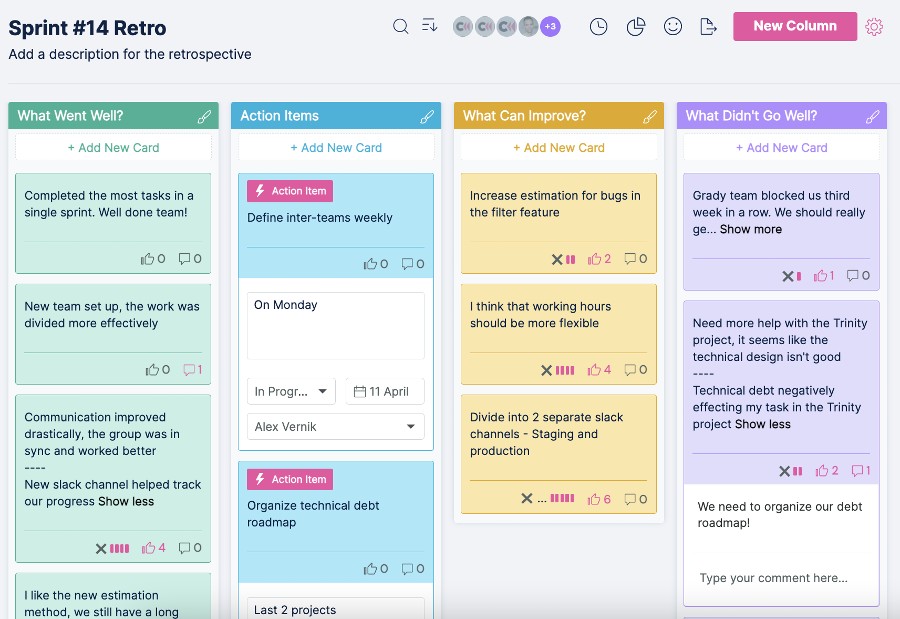
The retro boards do what you would expect: anonymous feedback, dot voting, timed discussions. The template library has 34 formats — 24 retro-specific plus 10 meeting templates for things like 1-on-1s, sprint reviews, and post-mortems. That is smaller than EasyRetro's 200+ options but covers everything most teams actually run. Start/Stop/Continue, Mad/Sad/Glad, 4Ls, Sailboat. The usual suspects.
Cards can be grouped manually. Action items you create during the retro carry forward into a persistent backlog between sprints, which is one of GoRetro's better ideas. Anonymous mode is configurable per board — a smart default for psychological safety.
Sprint Capacity Calculator
This is the feature that makes GoRetro different. No other tool in our rankings offers anything like it natively.
The calculator helps your team estimate bandwidth for an upcoming sprint by factoring in team size, planned time off, meetings, and other commitments. It will not replace a dedicated resource planning tool. But as a quick gut check during sprint planning? Surprisingly useful.
I have worked with teams that routinely over-committed by 20-30% every sprint. A tool like this forces the conversation before the sprint starts rather than after it derails.
The sprint capacity calculator is unique. No other tool in our rankings offers anything like it natively.
Planning Poker
GoRetro has planning poker, but here is the catch: it sits behind the Sprint Pro plan at $49/month. You get Fibonacci and custom scales, real-time estimation, outlier detection, and Jira story import. The experience is solid once you have access.
That price gating stings. Teams on the free or base Premium plan will need a separate tool for estimation. Kollabe includes planning poker on all plans including free. Parabol includes it from their free tier too. Paying $49/month for something competitors give away is a tough sell to any engineering manager reviewing the budget.
Jira Integration
This is GoRetro's strongest integration by far. You can import your Jira backlog into planning poker sessions, pull sprint data for velocity tracking, and push action items from retros into Jira as new issues. The April 2023 update added the ability to export poker estimations directly back to Jira, so estimates do not live in a separate tool that nobody checks.
For teams that live in Jira, the connection is tight. It feels like a natural extension rather than a bolted-on integration.
Slack Integration
The Slack integration is thin. It pushes action items from a retro board to a designated Slack channel. That's it. No retro start notifications, no meeting summaries, no inline interaction. Data flows one direction: GoRetro to Slack. Nothing comes back. Parabol does significantly more with its Slack and Teams connectivity.
Sentiment Tracking
GoRetro tracks team morale through a happiness index — a quick 1-5 scale that each participant clicks at the start or end of a retro. Over time, you get a trend line showing how the team's mood shifts sprint to sprint. Takes almost zero effort from participants, which means you actually get consistent data.
TeamRetro's dedicated health check surveys go deeper, digging into specific dimensions like collaboration, tooling, and workload. GoRetro's approach is blunter. One number, one trend line. But I have seen too many teams abandon detailed health surveys after a few sprints because they feel like homework. GoRetro's version is low-friction enough that people actually fill it out.
Pricing
GoRetro's pricing starts generous and gets expensive fast.
Free — unlimited users, 34 templates, anonymous feedback, voting, basic action items. One team, up to 5 public boards. No export, no integrations.
Premium ($29/month billed annually) — adds analytics, the happiness index, Jira and Slack integrations, unlimited public boards, and meeting recaps. Team-based pricing, not per-user. This is where most teams will land.
Sprint Pro ($49/month billed annually) — adds planning poker, the sprint capacity calculator, and advanced sprint analytics. The full sprint management experience.
Organization (custom pricing) — SAML/SSO, user management, dedicated account manager, volume discounts, and uptime SLA.
The free tier includes unlimited users, 34 templates, and 5 boards. More generous than most competitors for $0.
The jump from Premium to Sprint Pro is where it gets interesting. At $49/month you are paying $20 more than Kollabe's $29/month plan, which bundles poker, retros, and standups together. GoRetro's capacity calculator and sprint analytics may justify that gap for some teams, but you should run the numbers before committing.
Ease of Use
The interface is colorful — almost playful. Creating a retro takes about a minute. Participants do not need an account to join, and the board interactions feel snappy. Facilitator controls are easy to find without a tutorial, which matters when you are running a retro for the first time and 8 people are watching you figure out the tool.
The sprint management dashboard gives you a clean read on capacity and velocity. Nothing buried three clicks deep.
One minor annoyance: GoRetro has operated under both goretro.me and goretro.ai at various points. Some older links and docs still point to the previous domain. It is cosmetic, not functional, but it causes confusion when you are sharing join links with teammates or onboarding new people who Google the wrong domain.
Who Is It Best For?
GoRetro works best for teams that want their retro tool to do more than run retros. If your team struggles with chronic over-commitment or loses action items in the gap between sprints, GoRetro targets those problems directly. The sprint capacity calculator is genuinely unique among the tools we reviewed.
The free tier gives you enough runway to test whether the sprint management angle fits your workflow before you spend anything.
But if you need planning poker without paying $49/month, look at Kollabe or Parabol. If you need integrations beyond Jira and Slack, or enterprise compliance features like SOC 2, TeamRetro or Kollabe will serve you better.
The Verdict
GoRetro carved out a real niche by treating retrospectives as part of a bigger sprint management picture. The persistent action item backlog and capacity calculator set it apart from tools that treat each retro as a standalone event. G2 ratings back that up — people genuinely like using it.
The downsides are clear. Planning poker behind a $49/month paywall. An integration list that starts and ends with Jira and a bare-bones Slack connection — thin compared to TeamRetro's 15 integrations or Kollabe's support for Linear, GitHub, and Confluence. SOC 2 still pending. Data hosted exclusively in US Central.
If your team lives in Jira and wants capacity planning baked into your retro workflow, GoRetro is a smart pick. If you care more about ceremony breadth or getting poker without a premium price tag, Kollabe or Parabol are stronger overall. See our Kollabe vs GoRetro comparison for the full breakdown.