

Quick Verdict
This comes down to what your team actually needs beyond retros.
Kollabe covers retrospectives, planning poker, daily standups, and icebreakers in one platform. TeamRetro does retros and health checks really well, has SOC 2 Type II certification, and connects to 15 different tools. If compliance is a hard requirement or your team relies on standalone health checks to track improvement over time, TeamRetro is purpose-built for that. For everyone else running multiple agile ceremonies, Kollabe replaces two or three subscriptions with one and automates the parts of facilitation that eat clock time.
Where TeamRetro pulls ahead: SOC 2, Slack and Microsoft Teams integration, 15 export integrations, and a mature health check tool with trend tracking. Kollabe counters with planning poker (ticket import, auto-sync), async standups, AI grouping, and a lower effective cost for what you get.
Feature Comparison
The retro basics? Both handle them well. Anonymous brainstorming, voting, timers, action items, guided facilitation, templates. Both have AI summaries and AI grouping. The feature tables look similar until you zoom out.
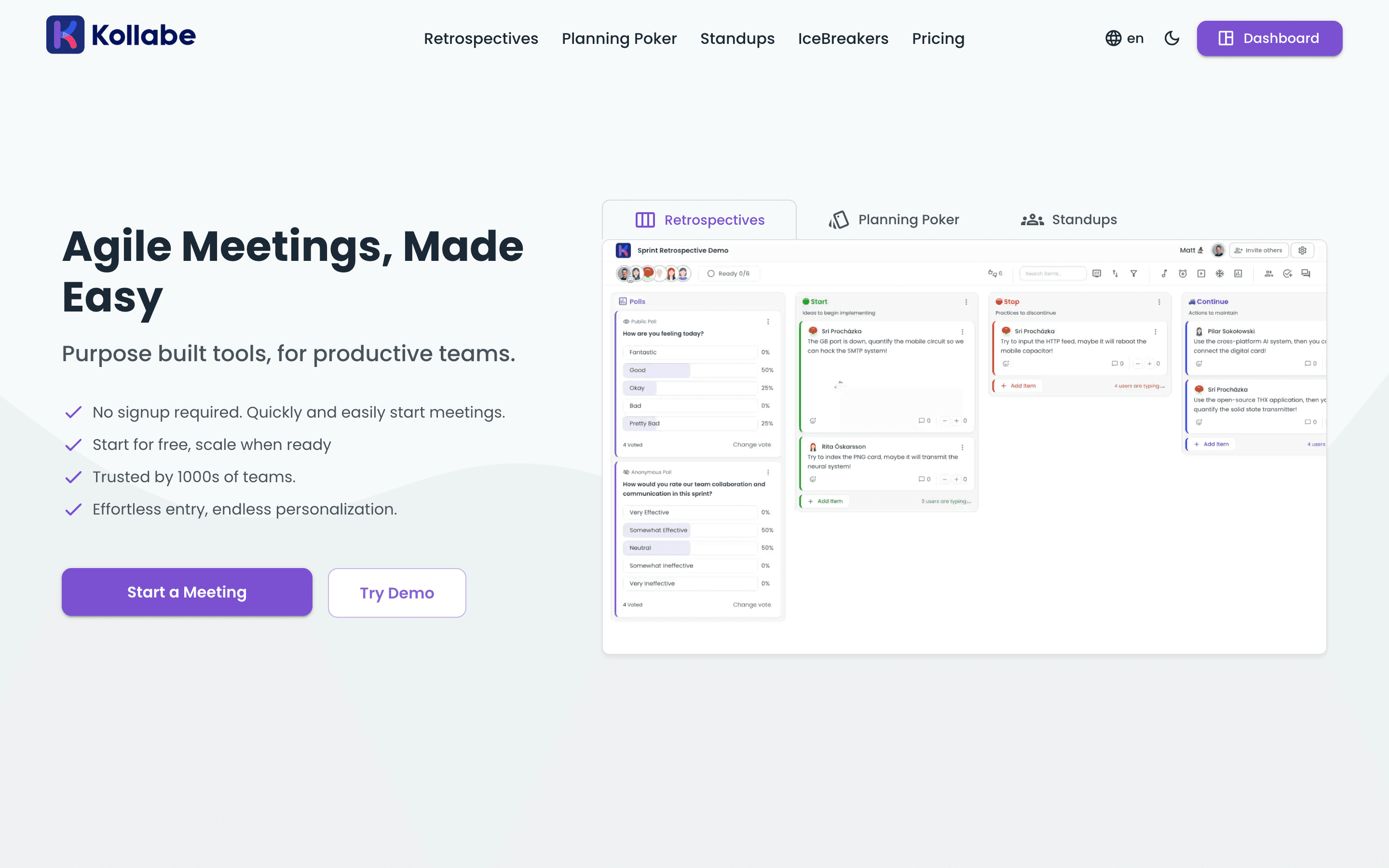
Kollabe is an all-in-one agile ceremonies platform. Beyond retros, it includes planning poker with Jira/GitHub/Azure DevOps/Linear ticket import and auto estimate sync, async daily standups with AI summaries, and 600+ icebreaker questions. Three tools, one subscription.
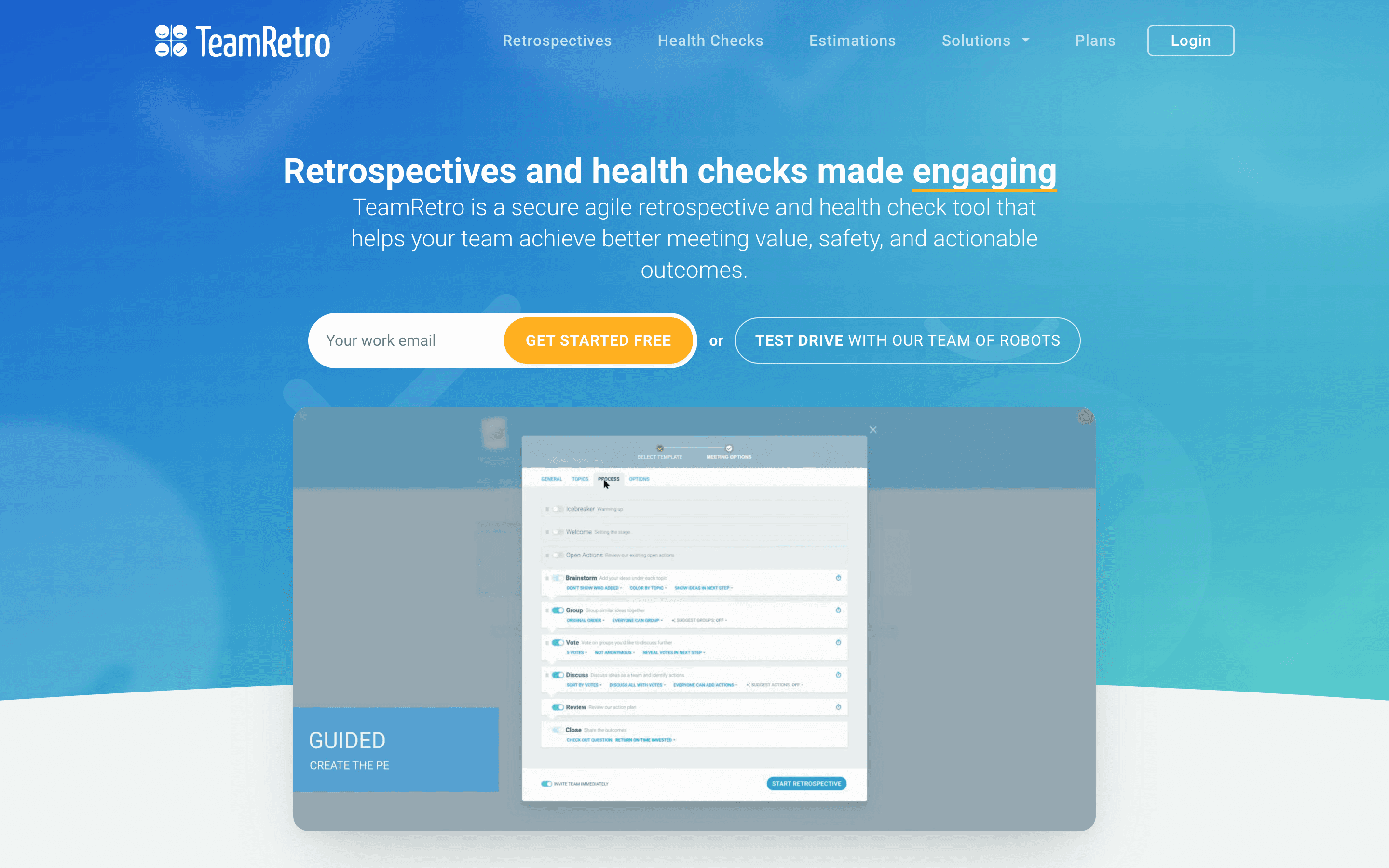
TeamRetro focuses on retros and health checks. The health check tool is genuinely good: 4 pre-built models plus 15 maturity model templates added in January 2026, with trend tracking over time. If your team runs quarterly squad health checks and wants to visualize improvement across dimensions, TeamRetro has a dedicated tool for that. Kollabe offers health check templates inside retros, but no standalone health check with trend tracking.
TeamRetro's health check tool is a real differentiator. It tracks team health scores across multiple dimensions over time with heat maps and dashboards. Kollabe has health check retro templates, but no dedicated tool that shows whether your "deployment confidence" score has improved over the last 6 sprints.
The template count tips toward Kollabe: over 1,000 templates plus an AI generator vs TeamRetro's 56+. TeamRetro has Lean Coffee as a built-in format, which Kollabe doesn't. Kollabe has inline polls, a drawing tool, themed retros with 30+ backgrounds, and full async retro support. TeamRetro's async support is partial. Brainstorming can happen async, but grouping, voting, and discussion are designed for everyone to be in the room at the same time.
Pricing Comparison
Both use per-team pricing, but the structures play out very differently at scale.

Kollabe
Flat per team — retros, poker, and standups included
- Unlimited participants and history
- All AI features included
- All integrations included
- Free tier available (10 participants)

TeamRetro
Single team — retros and health checks only
- Up to 25 members per team
- SAML SSO on all paid plans
- SOC 2 Type II certified
- No free tier (30-day trial)
At face value, TeamRetro's single team plan is $4/month cheaper. But that $25 gets you retros and health checks only — no planning poker, no standups. If you need a separate poker tool ($10-15/month) and a standup tool ($20-30/month), Kollabe's $29 is the cheaper total.
Multi-team pricing is where TeamRetro gets expensive fast. Three teams costs $60/month on TeamRetro vs $87/month on Kollabe (3 x $29). But Kollabe's $87 includes poker and standups for all three teams. To match that with TeamRetro, you'd add separate poker and standup subscriptions on top of $60.
One thing TeamRetro does better here: SSO/SAML is included on every paid plan. Kollabe gates SSO behind Enterprise pricing. For organizations where SSO is mandatory but budget is tight, that's a meaningful difference.
Ease of Use
TeamRetro's facilitation flow is more structured. It walks you through Set the Stage, Brainstorm, Group, Discuss, and Actions in a strict sequence. There's a presentation mode that locks participants to the same view. Music during brainstorming. A parking lot for off-topic items. It's built by people who clearly facilitate a lot of retros.
Kollabe's flow is more flexible. You get guided phases, but facilitators can jump between them. The AI grouping means you skip the manual clustering step entirely. For experienced facilitators who want control, this flexibility is better. For new scrum masters who want guardrails, TeamRetro's rigid structure helps prevent the "everyone's on a different screen" problem.
Both are browser-based with no install required. Neither has native mobile apps.
Integrations
TeamRetro has the wider integration footprint: 15 tools including Jira, GitHub, Slack, Azure DevOps, Linear, Confluence, Trello, Microsoft Teams, Asana, Basecamp, ClickUp, Monday.com, Notion, Shortcut, and GitLab. All export-oriented. You push action items and summaries out.
Kollabe connects to fewer tools (Jira, GitHub, Azure DevOps, Linear, Confluence) but goes deeper. Jira integration includes JQL-based ticket import for planning poker, auto-sync of estimates back to Jira story points, and action item export. That two-way data flow matters for teams where the facilitator imports the sprint backlog directly into a poker session.
Kollabe has no Slack or Microsoft Teams integration. TeamRetro can post retro summaries and team agreements directly to both. If your team's workflow depends on Slack notifications for meeting outcomes, that's a gap Kollabe hasn't closed yet.
TeamRetro added two-way Jira sync for action item titles and completion status in December 2025, narrowing Kollabe's depth advantage on the Jira side. But Kollabe's ticket import and auto estimate sync for planning poker sessions remains unique.
AI and Automation
Both tools have AI summaries and AI grouping. The difference is how far the AI reaches.
Kollabe's AI covers all its ceremonies, not just retros. Retro summaries are customizable with custom AI instructions, so you can tell the AI to focus on deployment issues or team morale specifically. Standup summaries can be daily, weekly, or fortnightly. There's also an AI template generator and sentiment analysis that tracks mood trends over time.
TeamRetro's AI covers retros and health checks. The sentiment timeline analysis (added May 2025) tracks team sentiment across retros with heat maps. AI-generated icebreaker questions are a nice touch. AI grouping suggests affinity clusters during the brainstorm phase.
Neither tool is pushing the boundaries of what AI can do here. Both handle grouping and summaries. Kollabe has the edge because its AI works across three ceremony types instead of one, and the custom AI instructions give facilitators control over what the summary actually focuses on.
Who Should Choose Which?
Choose Kollabe if…
- Your team runs retros, poker, and standups and wants one tool instead of three
- You need ticket import and auto estimate sync for planning poker sessions
- You want fully async retros and standups, not just async brainstorming
- Flat $29/month pricing beats paying for retros, poker, and standups separately
- You use GitHub, Linear, or Azure DevOps for ticket import and estimate sync
Choose TeamRetro if…
- SOC 2 Type II compliance is a hard requirement from your security team
- You need standalone health checks with trend tracking over quarters
- Your team relies on Slack or Microsoft Teams for retro summaries and notifications
- You integrate with 10+ tools (Asana, ClickUp, Monday.com, Notion, GitLab, etc.)
- You want SAML SSO included on every paid plan, not gated behind Enterprise
Final Recommendation
For most agile teams, Kollabe is the smarter buy. One $29/month subscription covers retros, planning poker, and daily standups with AI across all three. TeamRetro charges $25/month for retros and health checks, then you're paying for separate tools to cover everything else.
TeamRetro earns its spot for a specific type of team, though. If your organization requires SOC 2 compliance, runs quarterly health checks with trend tracking, or lives in Slack and Microsoft Teams, TeamRetro is built for exactly that. Its 15 integrations and structured facilitation flow come from years of focus on the enterprise retro use case.
Pick Kollabe if you want one platform for all your ceremonies. Pick TeamRetro if compliance and health checks are what keep you up at night. For a broader look at how these compare to other options, check our retrospective formats guide.