

Quick Verdict
This is a comparison between two different decades of retro tooling, and it mostly reads that way.
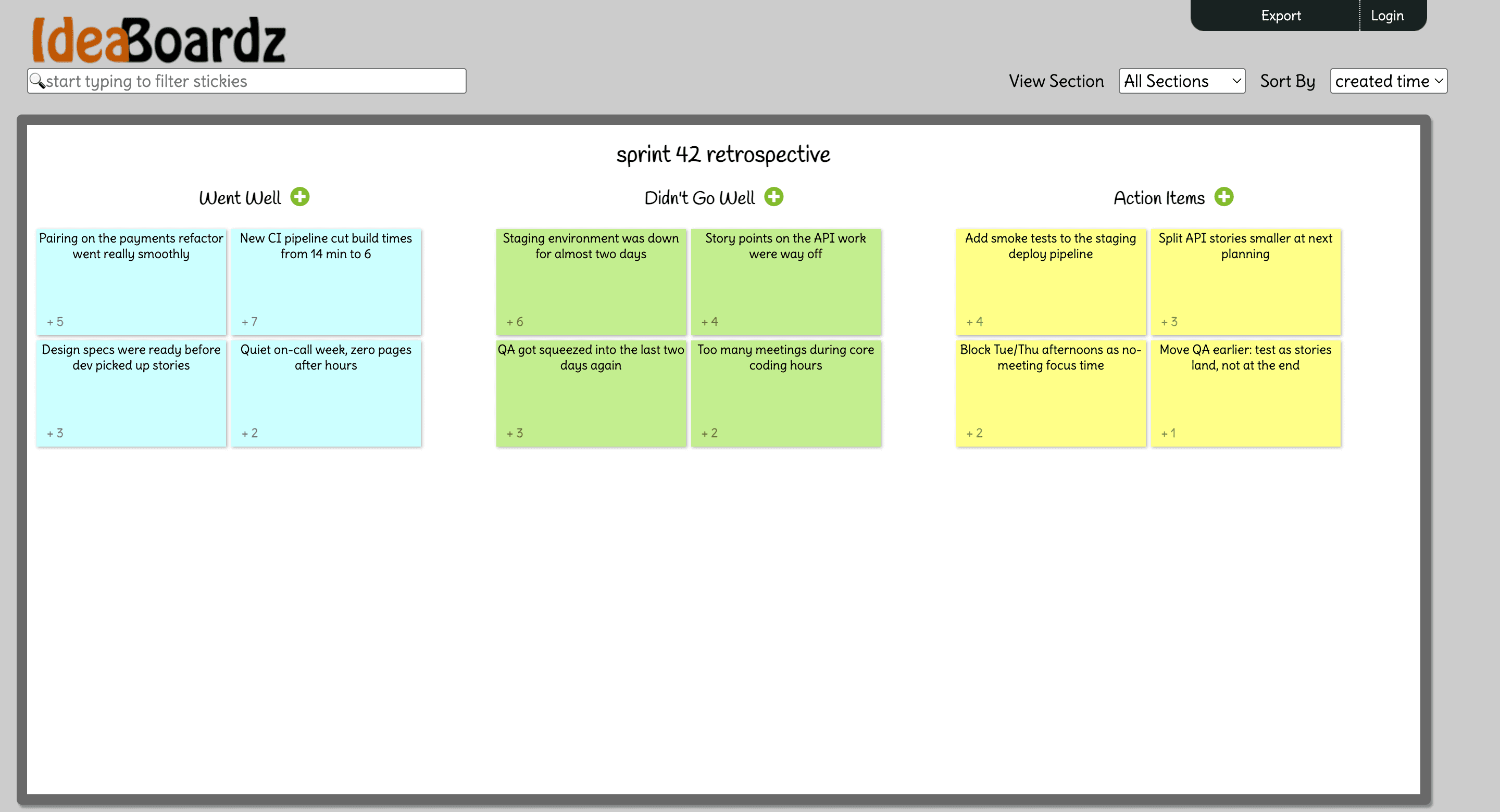
IdeaBoardz is a free Thoughtworks side project from around 2010 that still works: create a board, share the URL, collect anonymous stickies and dot votes. No accounts, no pricing page, no limits. As a zero-cost async inbox for retro input, it remains quietly useful, which is why it has outlived most of its generation.
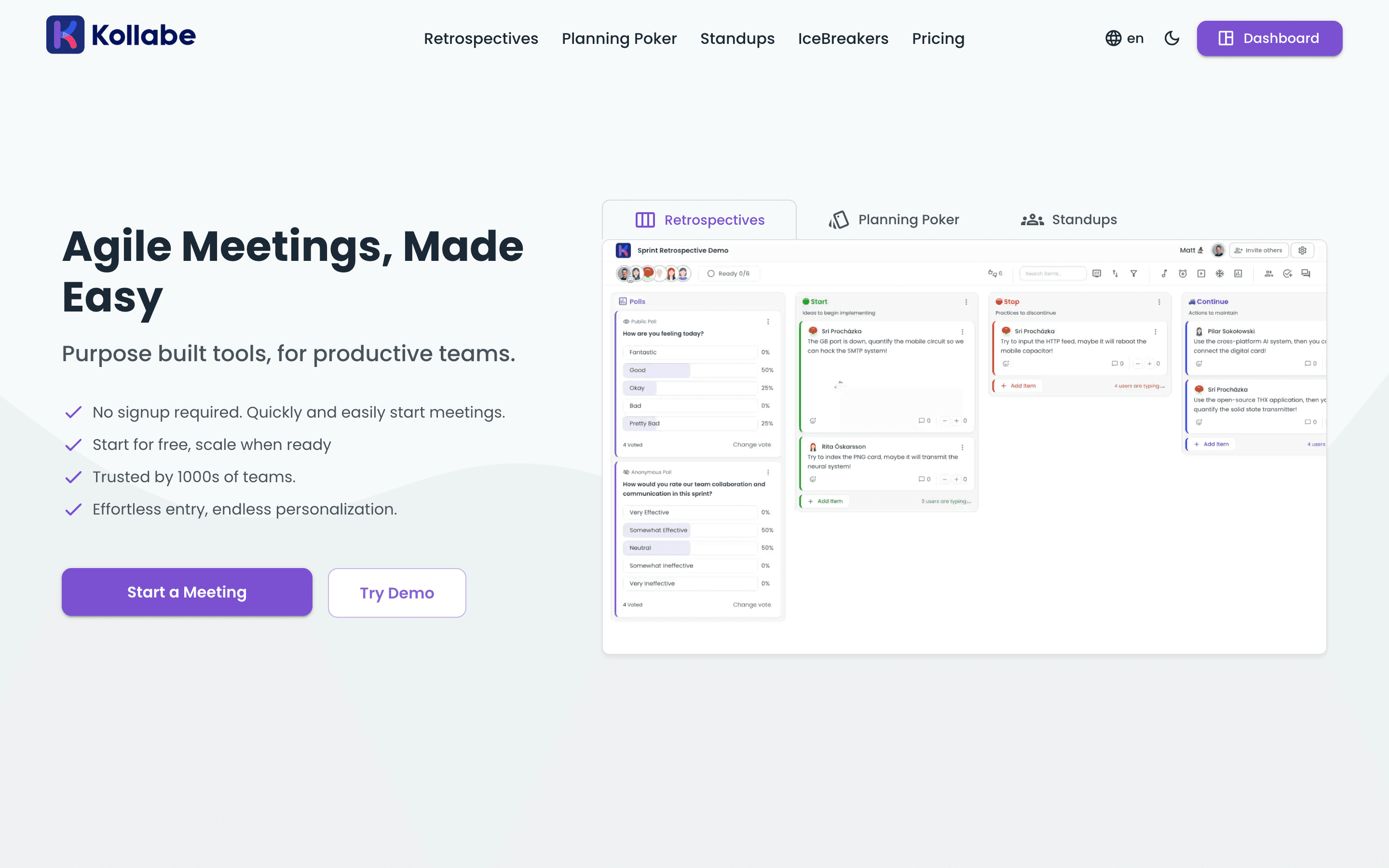
Kollabe is what fifteen more years of retro tooling look like. Guided phases, timers, 1,000+ templates, AI grouping and summaries, action items with owners and due dates, and then planning poker and async standups in the same $29/month subscription. If your team runs ceremonies every sprint and expects the tool to remember what happened last time, this is not a close call. Kollabe wins.
The reason to keep reading is budget. If the answer to "what can we spend" is genuinely nothing, IdeaBoardz deserves a fair look.
Feature Comparison
The overlap is thin: both do anonymous cards, dot voting with configurable limits, and multi-section boards. IdeaBoardz offers five preset formats (including a Starfish retro and Six Thinking Hats) or up to ten custom-named sections. Kollabe has around 1,052 templates plus an AI generator that builds a format from a theme you type in.
From there, everything on the modern checklist is one-sided. Timer: Kollabe has three kinds (session, per-item, voting phase), IdeaBoardz has none. Grouping similar cards: Kollabe does it with AI by semantic similarity, IdeaBoardz cannot merge two stickies even manually. Facilitation: Kollabe has customizable guided phases; IdeaBoardz has a hide-cards toggle. Action items: Kollabe assigns owners and due dates and carries unfinished items into the next retro; IdeaBoardz exports a PDF and wishes you luck.
One genuine IdeaBoardz strength deserves the ink: friction. There is none. Nobody logs in, ever, including the facilitator's whole team. Boards live at a permanent URL, so collecting thoughts asynchronously over a week works with zero process. Kollabe supports async retros properly, but participants still land in an actual product.
IdeaBoardz has no access control of any kind. Anyone with the board URL can read and edit everything — there are no private boards, no roles, and no way to lock it down. Never use it for retros that touch personnel, security, or anything you would not post publicly.
Pricing Comparison
One of these tools has a pricing page. The other has a sentence in its FAQ that says "It is free."

IdeaBoardz
No paid tier exists — unlimited everything
- Unlimited boards and participants
- No accounts or logins required
- Dot voting and PDF/Excel export included
- No ads, no upsell

Kollabe
Flat per team — retros, poker, and standups included
- Unlimited participants and history
- All AI features included
- Planning poker and async standups included
- Free tier available (10 participants)
You cannot beat free, so the interesting question is what $29/month actually buys. The answer: the entire meeting after the stickies are written. Grouping, timers, discussion structure, summaries, action items that come back next sprint, plus two additional ceremonies. Teams that would otherwise pay separately for a poker tool come out ahead on Kollabe's flat fee alone.
Worth noting: Kollabe's own free tier (up to 10 participants, 7-day history) covers small teams better than most free plans in this directory, so the zero-budget comparison is not automatically IdeaBoardz's to win. IdeaBoardz keeps unlimited history; Kollabe's free tier forgets after a week. That trade matters more for some teams than others.
The uncomfortable IdeaBoardz caveat is sustainability. No revenue, no company, no visible development since roughly 2020. It has run for fifteen years on goodwill, and it may run fifteen more, but nobody owes you an SLA on a hobby project.
Ease of Use
IdeaBoardz is the easiest tool in this directory to get people into. Paste a URL, people add stickies. The UI is dated (it looks like 2012 because it is), but there is nothing to learn.
Kollabe requires the facilitator to create an account and a room, and participants to click through a slightly richer interface. That costs you a minute of onboarding and pays it back the moment the meeting starts: phases advance, timers run, cards group themselves, and the summary writes itself. IdeaBoardz sessions, by contrast, are all facilitator elbow grease: you sort by votes and talk through a wall of unmerged stickies.
Mobile is a real difference. Kollabe's responsive web app works fine on phones. IdeaBoardz technically loads on mobile but was never designed for it, and its old Android app is deprecated.
Integrations
Short section. IdeaBoardz has zero integrations. No Jira, no Slack, no API, no webhooks, nothing. Data leaves as PDF or Excel and re-enters your workflow by hand.
Kollabe connects to Jira, GitHub, Azure DevOps, and Linear with two-way flow — ticket import into poker sessions, estimate write-back to story points, action items exported as issues — plus Confluence export and a public API (added February 2026). Its own honest gap: no Slack or Microsoft Teams integration, which IdeaBoardz obviously does not fill either.
AI and Automation
IdeaBoardz predates the entire category. There is no AI anywhere, and no automation beyond sorting cards by vote count.
Kollabe's AI covers grouping by semantic similarity, summaries with custom instructions, sentiment and engagement trends, an AI template generator, and standup digests. Whether you care is a team-culture question, but the grouping alone erases the most tedious ten minutes of a retro, which happen to be the ten minutes IdeaBoardz makes you spend reading duplicate stickies aloud.
Who Should Choose Which?
Choose IdeaBoardz if…
- Your budget is zero, permanently
- You need frictionless async input collection with no logins
- Occasional retros or one-off brainstorms, not a sprint cadence
- Nothing sensitive will ever touch the board
- You already have somewhere else to track follow-ups
Choose Kollabe if…
- You run retros every sprint and want them to compound
- Action items need owners, due dates, and carryover
- You also run planning poker and standups
- AI grouping and summaries save real facilitation time
- You need Jira, GitHub, Azure DevOps, or Linear in the loop
Final Recommendation
For a working agile team in 2026, Kollabe is the obvious pick. IdeaBoardz isn't bad. It just stops where the actual work of a retrospective begins. Collecting stickies is the easy 20%. The grouping, the discussion structure, the accountability, and the memory between sprints are the hard 80%, and IdeaBoardz simply does not attempt them.
IdeaBoardz still earns a recommendation in its niche: zero budget, zero setup, zero sensitivity. Community groups, classrooms, one-off workshops, and teams collecting anonymous input before a discussion that happens somewhere else. Our free retro tools guide covers that whole category if free is a hard requirement.
If you have $29 a month, spend it. If you do not, IdeaBoardz with a phone timer and a disciplined facilitator beats no retro at all.