

Quick Verdict
These two tools take opposite approaches to improving your sprint retrospectives.
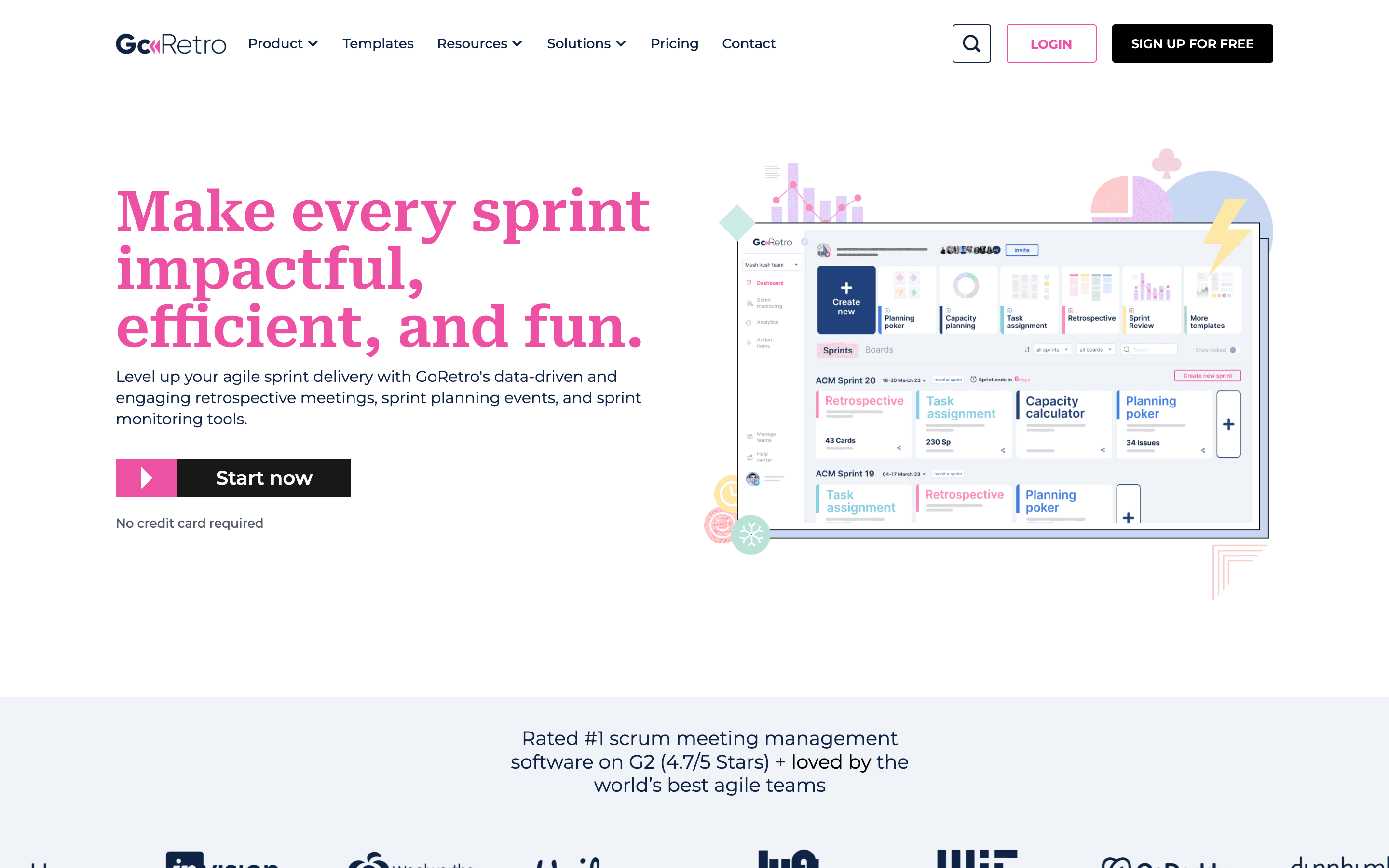
GoRetro wants to be your sprint command center. Connect Jira, track velocity, run planning poker, and do retros — all in one place. It's the only retro tool that pulls live sprint data and generates discussion prompts from your actual metrics. There's a free tier, per-team pricing, and a focus on Jira-centric engineering teams.
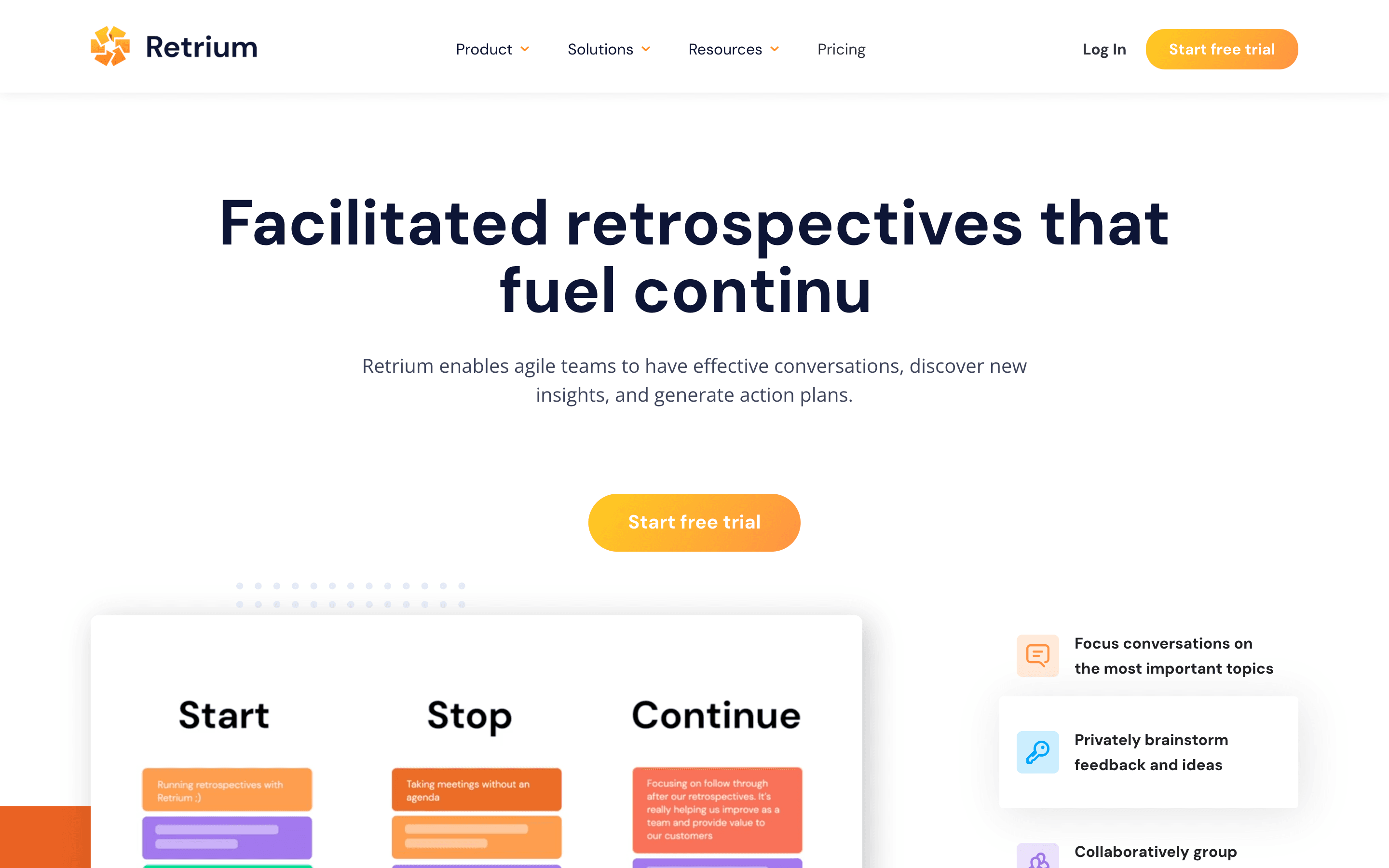
Retrium just does retros, but it does them better than almost anyone. Five-phase guided facilitation walks your team from brainstorming through action items without the facilitator needing to improvise. Team Radar tracks health over time. Async mode handles distributed teams. SOC 2 Type II means procurement won't block you. The tradeoff: no planning poker, no free tier, and $39/month per team room.
Pick GoRetro if your retros need sprint context. Pick Retrium if your retros need structure.
Feature Comparison
The retro core is similar: anonymous feedback, voting, timers, action items, 30+ templates in each, and custom template builders. What separates them is everything around that core.
Retrium's guided workflow is the feature that defines it. Every retro moves through Think, Group, Vote, Discuss, and Wrap Up. The facilitator advances phases, and each step has guardrails — notes are blurred during Think to prevent groupthink, voting counts auto-calculate based on group size, and Wrap Up prompts team feedback on the retro itself. You can't skip steps. You can't let the meeting spiral. If your team rotates Scrum Masters or hands facilitation to whoever drew the short straw, this matters a lot.
GoRetro gives facilitators manual controls instead. Hide cards, disable voting, set vote limits, run a timer. It works, but the facilitator has to know what to do and when. There's no guided flow telling them "now it's time to vote" or "let's group these before discussing."
Retrium's Team Radar lets you track team sentiment across custom categories (code quality, collaboration, deployment confidence) over multiple sprints. If you're an engineering manager who needs to show that retrospectives are actually driving improvement, this is how you do it. GoRetro has a happiness index, but it's a single 1-5 score, not the same thing.
Where GoRetro pulls ahead: sprint monitoring. Connect Jira and it tracks velocity trends, cycle times, and mid-sprint anomalies. "Joker Cards" generate discussion prompts from your sprint data automatically. No other retro tool does this. GoRetro also has planning poker with Jira backlog import and estimate sync — Retrium doesn't estimate at all.
Retrium counters with async retros (facilitator sets a timeframe, team submits on their own schedule), Lean Coffee as a built-in technique, and health checks via Team Radar. GoRetro has none of these.
Pricing Comparison
Both charge per team, but the models differ in important ways.

GoRetro
Premium plan, billed annually
- Free tier: 1 team, 5 boards
- Sprint Pro $49/mo adds poker
- Unlimited users per team
- No exports on free plan

Retrium
Unlimited users per room
- No free tier (30-day trial)
- SOC 2 and SSO on Business ($59/mo)
- All techniques included at base tier
- Unused rooms can be reassigned
GoRetro's free tier gets you started without procurement approval — one team, five boards, unlimited users. That's enough for a month or two of biweekly retros. The $29 Premium plan adds exports, Slack, and advanced action items. Planning poker requires Sprint Pro at $49/month.
Retrium starts at $39/month per team room after a 30-day trial. No free tier. But everything is included: all 11+ techniques, guided facilitation, Team Radar, async mode. SSO and SOC 2 audit access require the Business plan at $59/month. For a single team, that's $10/month more than GoRetro Premium. You're getting guided facilitation and health tracking for that extra $10, which is an easy call for most mid-size teams. For organizations with 10+ teams, talk to both vendors. Volume discounts change the math.
Ease of Use
GoRetro is faster to get started. Pick a template, share a link, collect cards. Guests don't need accounts. You can be running a retro in under a minute. The downside is that the quality of your retro depends entirely on whoever's facilitating. A great Scrum Master gets great results. A new one might rush through voting or forget action items entirely.
Retrium asks everyone to create an account, and the guided workflow takes a session to learn. But that structure is the point. The tool enforces good retro habits regardless of who's running the meeting. Notes are hidden during brainstorming so people think independently. Voting happens after grouping, not during. The Wrap Up phase ensures action items get assigned before anyone leaves. Experienced facilitators already do all of this. Retrium just makes sure it happens even when they're not in the room.
If your team rotates facilitators, Retrium is the safer pick. The retro quality stays consistent because the tool guides the process. With GoRetro, quality varies with whoever's driving.
Integrations
GoRetro connects to Jira and Slack. That's it.
The Jira connection is deep, though. Import backlogs for planning poker, sync estimates back, pull sprint velocity and cycle time data for the monitoring dashboard. If you live in Jira, this integration alone might justify GoRetro. Slack gets action item notifications on premium plans.
Retrium connects to more tools. Jira Cloud for action item export with cross-reference links. The Slack integration goes further than GoRetro's: team members can join retros from Slack, track progress in real time, and get weekly Monday summaries of outstanding action items. GitHub, Trello, ClickUp, and Asana handle action item export. Microsoft Teams is listed as supported.
Neither tool connects to Linear, Azure DevOps, or Confluence. If your team uses those, check Kollabe or Parabol, which cover all three.
AI and Automation
Neither tool is strong here.
Retrium has no AI features. No summaries, no grouping, no suggestions. Everything is manual or facilitator-driven. The guided workflow compensates a bit. The structured grouping phase forces you to organize cards methodically even without AI. But you're still reading and dragging cards yourself.
GoRetro's AI story is murky. Marketing references a "meeting recap" feature, but GoRetro's own features page doesn't mention AI, and multiple competitor comparisons list AI summarization and grouping as absent. There may be a basic recap, but good luck confirming whether it's genuinely AI-powered or just a formatted export. The "Joker Cards" feature does auto-generate discussion prompts from sprint data, which counts as automation, but that's sprint analytics, not retro AI.
If AI-driven facilitation matters to your team, neither of these is the answer. Look at tools with verified AI grouping and summaries, like Parabol or Kollabe.
Who Should Choose Which?
Choose GoRetro if…
- Your team lives in Jira and wants sprint velocity data inside retros
- You need planning poker with Jira backlog import
- A free tier matters — you can't wait for budget approval
- Per-team pricing works for your 15+ person team that only needs retros
Choose Retrium if…
- You want guided facilitation that keeps every retro structured and productive
- Team Radar health tracking matters for measuring continuous improvement
- Async retros are a must for your distributed team
- SOC 2 Type II certification is a procurement requirement
- You need action items pushed to Jira, GitHub, Trello, or Slack automatically
Final Recommendation
Retrium is the better retrospective tool. Guided facilitation, async support, Team Radar, SOC 2. Run retros every two weeks for a year with Retrium and you'll notice the difference: the structured workflow keeps bad habits from creeping back in, and the health tracking shows whether things are actually getting better.
GoRetro's strength is sprint context. If your engineering leadership wants retro discussions grounded in velocity data and cycle time trends, GoRetro is the only tool that pulls that from Jira automatically. Planning poker with backlog import is a bonus. The free tier removes the procurement barrier entirely.
One more thing: Retrium shipped updates through August 2024 and seems to have a clear product direction. GoRetro's last public changelog entry is May 2023. That doesn't mean the product is dead, but when you're picking a tool your team uses every sprint, knowing that the vendor is actively building matters.