

Quick Verdict
These two tools are solving different problems, and that's the whole comparison.
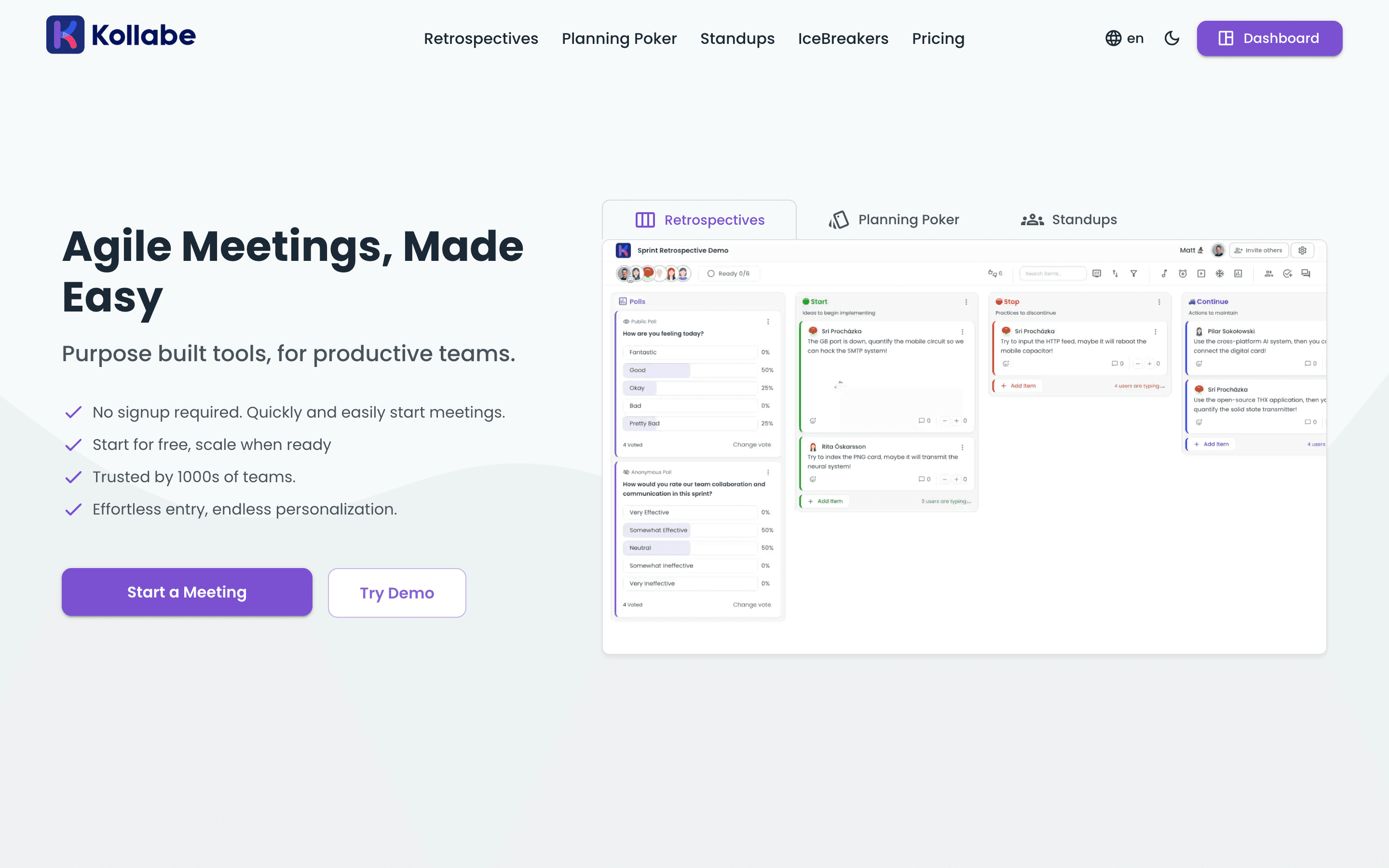
Kollabe is an all-in-one agile ceremonies platform. Retros, planning poker, async daily standups, and 600+ icebreakers, all for a flat $29/month per team. If your team needs to run more than just retros, it replaces two or three subscriptions with one.
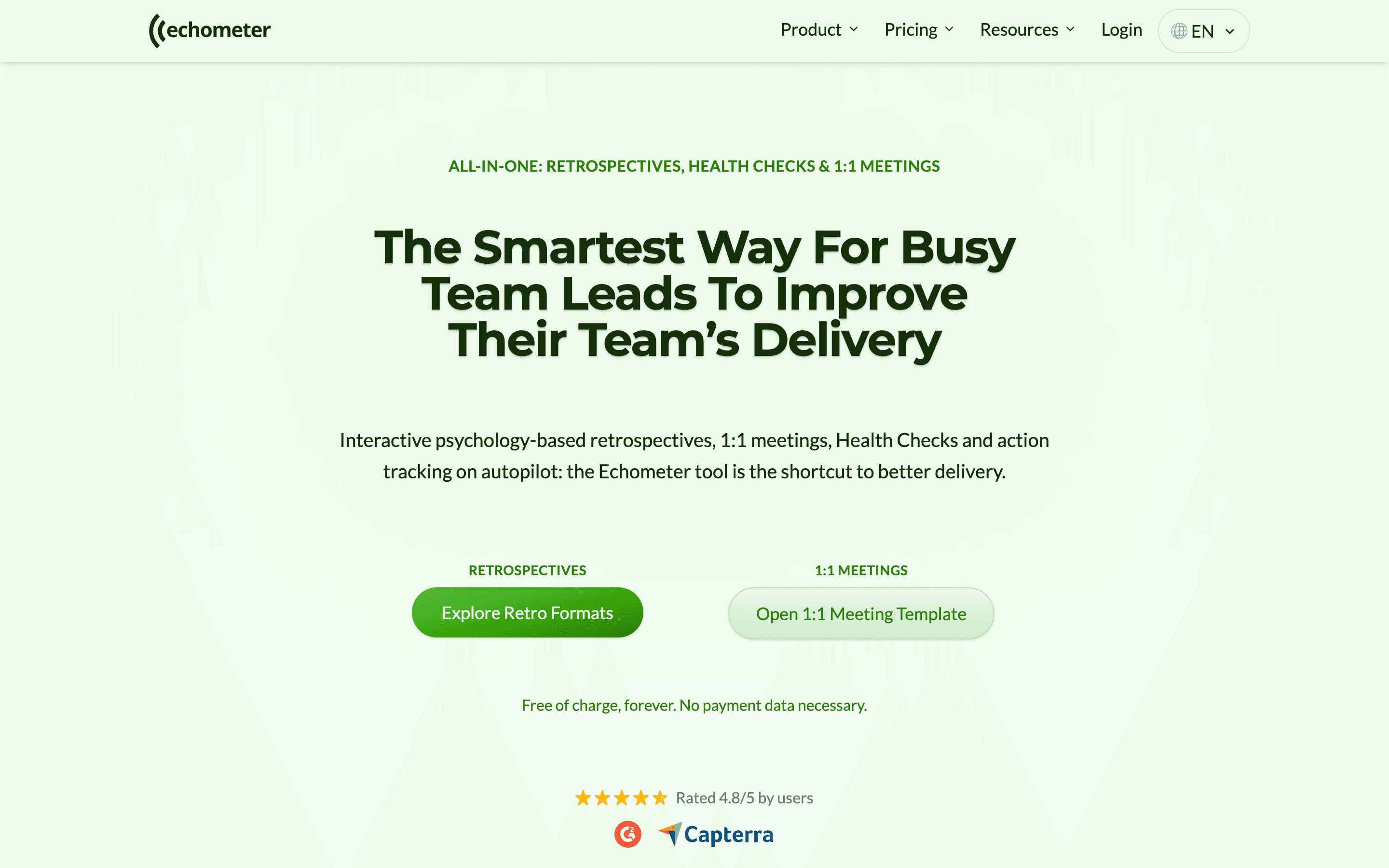
Echometer is a focused, research-backed team-health tool that happens to run good retrospectives. It came out of the University of Munster's psychology faculty, and it shows. The product is built around a "measure, reflect, act" loop with a standalone health-check tool, 200+ health-check questions, and trend tracking over time. If your real goal is measuring team health across squads and watching it improve quarter over quarter, Echometer does that better than Kollabe does.
For most scrum teams, though, Kollabe is the better buy. You get more ceremonies, a wider retro toolkit, and AI that does more of the facilitation grunt work.
Feature Comparison
Both tools cover the retro basics competently. Anonymous brainstorming, dot voting, timers, action items tracked across sprints, guided facilitation, a decent template library. Echometer ships 54+ retro formats; Kollabe has over 1,000 templates plus an AI generator that builds a custom format from a theme or goal you type in.
The split shows up the moment you look past retros.
Kollabe runs planning poker with Jira, GitHub, Azure DevOps, and Linear ticket import, plus auto-sync of winning estimates back to story points. It runs async daily standups in persistent daily rooms with AI summaries. Echometer does neither. No planning poker, no standups. That's not a knock on Echometer, it's just a narrower product.
Where Echometer pulls clearly ahead is team health. Its health check is a standalone, integrated tool, not a retro template. You pick from 200+ research-backed questions (or the Spotify Health Check model), run them on a recurring cadence, and the tool charts each dimension over time. It also tracks ROTI scores at every retro check-out, so you can see whether your retros are actually worth the hour. Kollabe has health-check retro templates, but no dedicated tool that shows whether your "deployment confidence" score has moved over the last six sprints.
Echometer's health-monitoring depth beats Kollabe's, full stop. If you run quarterly squad health checks and need to chart trends across dimensions over time, that's a standalone tool in Echometer and only a retro template in Kollabe. Buy Echometer for the measurement program, not the retros alone.
On the retro toolkit itself, Kollabe goes wider: inline polls any member can launch mid-retro, a built-in drawing canvas, 30 themed backgrounds, kudos, threaded comments with emoji and GIF reactions, and six export formats (PDF, Markdown, JPEG, CSV, JSON, Confluence). Echometer exports to PDF and Markdown only, and emoji reactions on cards aren't part of its flow. Echometer counters with a real strength of its own: cards stay concealed during brainstorming to prevent anchoring bias, which is a thoughtful, research-grounded default that Kollabe doesn't enforce.
Pricing Comparison
Both tools price per team with unlimited members, which makes the headline numbers easy to compare. Just mind the currency.

Kollabe
Flat per team — retros, poker, and standups included
- Unlimited participants and history
- All AI features included
- Planning poker and async standups included
- Free tier available (10 participants)

Echometer
Per team, annual billing — retros and health checks
- Unlimited team members
- Standalone health-check tool included
- Unlimited retros and archive
- Free tier (1 retro/month after trial)
At the same €29 / $29 sticker, the two Pro tiers cost roughly the same per team. But Kollabe's $29 includes planning poker and standups; Echometer's €29 buys retros and health checks. If you'd otherwise pay for a separate poker tool and a standup tool, Kollabe is the cheaper total by a wide margin.
Echometer's monthly billing is steeper at €35/team (vs €29 on annual), and its Business tier runs €49/team/year for SAML SSO and security filters. Kollabe gates SSO behind custom Enterprise pricing, so for a single team that just needs SAML, Echometer's €49 Business plan is the more predictable path.
One honest caveat on both: per-team pricing punishes orgs with many small teams. Ten five-person squads is ten subscriptions on either platform. Neither tool is the value play if you're spread thin across lots of tiny teams.
Ease of Use
Echometer's flow is opinionated in a good way. It walks facilitators through a step-by-step agenda with timed phases, concealed cards, blind "Live Voting," and a ROTI check-out at the end. For a new scrum master, that structure is a safety net. The psychology-backed defaults mean you fall into good facilitation habits without reading a book first.
Kollabe is more flexible. You get guided phases too, but facilitators can move between them freely, and AI grouping removes the manual clustering step entirely. Experienced facilitators tend to prefer the control. Newer ones may miss Echometer's guardrails.
Both run in the browser with no install. Both are responsive enough for someone to join a hybrid retro from a phone. Neither has a native mobile or desktop app.
Integrations
This is Kollabe's clearest win, and it isn't close.
Kollabe connects to Jira, GitHub, Azure DevOps, and Linear, with two-way data flow: JQL ticket import into poker sessions, auto-sync of estimates back to story points, and action-item export. It also exports retro results to Confluence. Echometer's integration story is mostly one-way to Jira: you can push action items into a Jira project, and that's about the extent of the developer-tool connections.
Neither tool has a real Slack or Microsoft Teams integration. Both mention notification-style updates, but if your team lives in Slack and expects retro summaries and action items posted to a channel automatically, you'll be disappointed by either. This is a shared gap, not a tiebreaker.
Echometer does offer one thing Kollabe doesn't: Google and Microsoft calendar sync, though that's tied to its separate 1:1 meeting product rather than retros. For pure agile-tool plumbing, GitHub, Linear, and Azure DevOps support put Kollabe well ahead.
AI and Automation
Both tools use AI, and both keep it practical rather than flashy.
Echometer generates AI summaries of retrospectives and suggests action items and measures for the topics that come up. Its 1:1 product adds AI coaching on facilitation technique. What it doesn't do is AI grouping, so clustering similar cards is still a manual drag-and-drop job. There's no per-card or word-cloud sentiment analysis either, though the health-check trends serve a similar purpose at the team level over time.
Kollabe's AI reaches further. It groups cards by semantic similarity (not just keyword matching), writes summaries you can steer with custom instructions, tracks sentiment and engagement trends, and runs across standups too with daily, weekly, or fortnightly digests. The AI template generator is a nice extra.
Neither is rewriting the rules of retro facilitation. But Kollabe's AI does more of the work in the room and spans more ceremonies, while Echometer's strongest "automation" is really its measurement loop, surfacing open action items and health trends in the next session automatically.
Who Should Choose Which?
Choose Kollabe if…
- Your team runs retros, planning poker, and standups and wants one tool instead of three
- You need ticket import and auto estimate sync for poker sessions
- You use GitHub, Linear, or Azure DevOps and want two-way integration
- You want AI grouping, steerable summaries, and a deeper retro toolkit
- Flat $29/month covers every ceremony with unlimited participants
Choose Echometer if…
- Your core goal is measuring and improving team health over time
- You want a standalone health-check tool with trend tracking, not just templates
- You value a psychology-backed, research-grounded facilitation flow
- You're running an org-wide team-health program across many squads
- EU data residency matters: Echometer hosts in Germany (ISO 27001 data center)
Final Recommendation
For most agile teams, Kollabe is the smarter pick. One $29/month subscription covers retros, planning poker, and standups, with the wider retro toolkit and the AI that actually saves facilitation time. If you only ever planned to run retros, you'd still get more out of Kollabe's templates, polls, and export options.
Echometer earns its place for a different buyer. If you're a coach, an agile lead, or a People team running a structured team-health program, its standalone health checks, 200+ research-backed questions, and trend tracking over time are built for exactly that, and Kollabe can't match it there. The German data residency and ISO 27001 hosting also matter for EU-based orgs.
So the question is what you're really buying. Pick Kollabe if you need a full agile ceremonies platform. Pick Echometer if measuring team health, not just running retros, is the job to be done. If you're still mapping out your options, our guide to the best retrospective tools covers where both land against the rest of the field.