

Quick Verdict
EasyRetro is a retro board. TeamRetro is a retro platform.
If your team needs a clean board to throw cards on, vote, and move on with their day, EasyRetro does that with less friction. No account required for participants, 200+ templates, done.
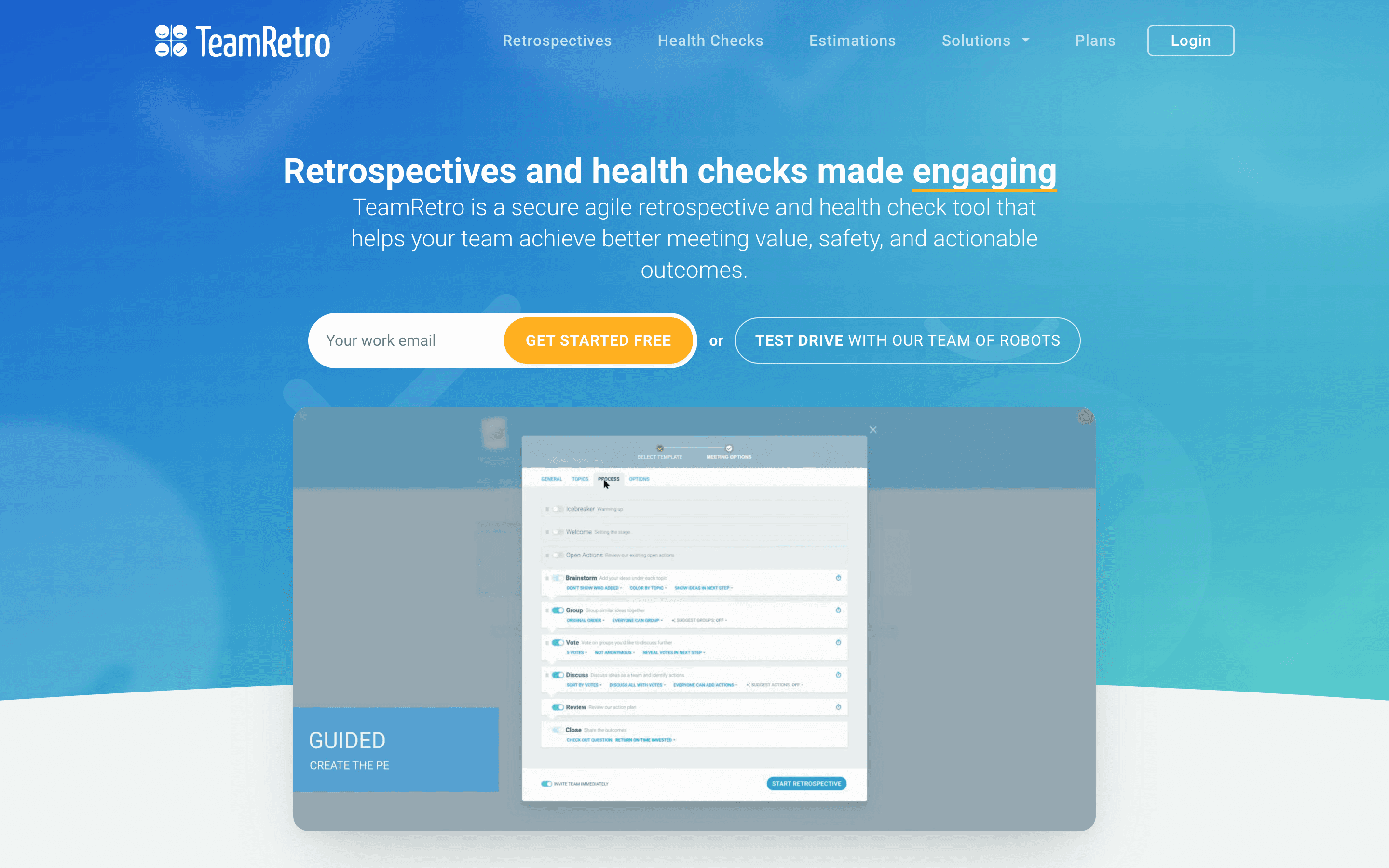
TeamRetro asks more of your team but gives more back. Guided step-by-step facilitation, AI-powered card grouping, health checks with sentiment tracking over time, planning poker, 15 integrations. It's actually cheaper at entry level ($25/month vs EasyRetro's $38/month) though there's no free tier. For teams that want retros to produce measurable change rather than a list of cards nobody looks at again, TeamRetro is the better investment.
Feature Comparison
Both tools nail the basics: anonymous feedback, voting, timers, action items with owners and due dates. The overlap ends there.
TeamRetro walks facilitators through each phase (brainstorm, group, vote, discuss, assign actions) with presentation mode keeping everyone on the same screen. If you've ever watched a junior Scrum Master freeze up during the grouping phase with 70 cards on the board, you know what unstructured facilitation looks like. TeamRetro's AI groups related cards automatically and tracks sentiment across retros with heat maps and trend lines. It added kudos badges, @mentions, GIF support, and quick polls throughout 2025, so sessions feel interactive without losing structure.
EasyRetro gives facilitators freedom instead of guardrails. The template library is genuinely massive, over 200 formats including creative ones you won't find anywhere else. There's a presentation mode for revealing columns one at a time, and a drawing tool for sketching directly on cards. But grouping is manual, there's no sentiment analysis, and the analytics are basic (last modified dates, action item status). Experienced facilitators who already run tight retros will prefer that flexibility. Everyone else will feel the gap.
Beyond retros, TeamRetro has standalone health checks with four pre-built models, 15 maturity templates, and trend tracking over time. It also ships planning poker with six estimation decks. EasyRetro has neither. If your team already pays for a separate health check or estimation tool, TeamRetro consolidates that spend.
Pricing Comparison
Both use flat-rate pricing rather than per-user fees, but TeamRetro is actually cheaper at the entry level: $25/month vs EasyRetro's $38/month.

EasyRetro
Team plan — flat rate, not per-user
- 5 boards/month, 1 team
- Free tier: 1 public board/month (barely functional)
- Business $60/mo: 15 boards, 3 teams
- SAML SSO only on custom enterprise pricing

TeamRetro
Single Team — up to 25 members
- Unlimited retros, health checks, and poker
- No free tier — 30-day trial only
- Small Org $60/mo: 3 teams, unlimited members
- SSO/SAML included on every paid plan
EasyRetro has a free tier, but it's barely functional: 1 public board per month, 1 board on your dashboard at any time. Archived boards count against the limit. You'd hit the wall after your first sprint. The Team plan at $38/month gives you 5 boards per month and 1 team. Business at $60/month bumps that to 15 boards and 3 teams. Large Business is $90/month for 30 boards and 6 teams. SAML SSO only comes with custom enterprise pricing.
TeamRetro has no free plan, just a 30-day trial. The Single Team plan at $25/month covers 1 team of up to 25 members with unlimited retros, health checks, and planning poker. Small Organization at $60/month gets you 3 teams with unlimited members. Large Organization starts at $90/month for 6 teams, with additional teams at $15/month each. One thing that stands out: SSO/SAML is included on every paid plan. Most competitors gate that behind enterprise tiers.
TeamRetro is $13/month cheaper at the single-team level and gives you health checks and planning poker at that $25/month. You'd need separate tools to get those with EasyRetro — and you'd be paying more for less.
Ease of Use
EasyRetro is simpler. Participants don't need accounts. Click a link, pick a name, start writing cards. The interface hasn't changed much in years, which is a compliment. Dark mode, keyboard shortcuts, card colors, all the small touches from a decade of polish.
TeamRetro has more surface area because it does more. First-time facilitators need to learn the step-by-step workflow, presentation mode, and when to advance phases. Not hard, but not instant either. Once you learn the flow though, the tool handles a lot of the facilitation work. AI does the card grouping, the timer keeps discussions from running over, and the guided steps mean you can't accidentally skip the action items phase.
A 5-person team doing a quick 30-minute retro? EasyRetro's simplicity wins. A 15-person team running a structured hour-long session? TeamRetro's guidance pays off. Match the tool's complexity to your team's size and ceremony length.
Integrations
TeamRetro connects to 15 tools, all export-oriented: Jira (with two-way sync as of December 2025), GitHub, Linear, Azure DevOps, Confluence, Slack, Trello, Microsoft Teams, Asana, Basecamp, ClickUp, Monday.com, Notion, Shortcut, and GitLab. That covers basically every project management tool a dev team might use.
EasyRetro connects to Jira Cloud, Confluence, Trello, Slack, and Microsoft Teams. No GitHub, no Linear, no Azure DevOps. If your team tracks work outside the Atlassian ecosystem, those gaps matter.
Neither tool has a public API or Zapier support. Both are export-only. You can push action items out but can't pull sprint data in.
AI and Automation
TeamRetro has gone deep on AI. Card grouping suggests clusters during the affinity mapping phase. Summaries generate post-meeting reports automatically. Sentiment analysis tracks team mood across retros with timeline visualizations. AI-generated icebreaker questions kick off sessions. They upgraded the underlying models in 2025.
EasyRetro has AI board summaries (added January 2024) and an AI template generator that creates custom retro formats from a prompt. Both useful, but they don't touch facilitation itself. The hard part of running a retro, grouping 60+ cards into themes, is still fully manual.
If your team generates a lot of feedback per sprint, AI grouping alone saves 10-15 minutes per session. Over a year of biweekly sprints, that's roughly 4-6 hours of facilitator time recovered. EasyRetro doesn't offer AI grouping — only manual drag-and-drop.
Who Should Choose Which?
Choose EasyRetro if…
- Your team wants a retro board and nothing else — no health checks, no poker, no standups
- Your facilitators already know what they're doing and don't need guided workflows
- You like rotating through a huge template library (200+) to keep retros fresh
- You want a free tier to start with, even if it's limited
- You're deep in the Atlassian ecosystem (Jira, Confluence, Trello) with Slack notifications
- You value longevity — EasyRetro has been running since 2015 with over a million retros facilitated
Choose TeamRetro if…
- You need retros, health checks, and planning poker in one platform
- Your organization has compliance requirements: SOC 2 Type II, GDPR with data residency, SCIM provisioning
- Your team uses GitHub, Linear, or Azure DevOps — not just Atlassian tools
- Your facilitators rotate or vary in experience and you need consistent retro quality
- You want sentiment tracking that gives engineering managers real data on team health over time
- SSO/SAML on every paid plan matters to your IT team
Final Recommendation
At $25/month, TeamRetro gives you guided facilitation, AI grouping, health checks, planning poker, sentiment analysis, SOC 2, and 15 integrations. EasyRetro costs $38/month and gives you simplicity and the biggest template library on the market.
If all your team needs is a board to collect feedback and vote on it, EasyRetro works. It's simple, proven, and has a free tier.
But most teams outgrow "just a board" once they start taking retros seriously. TeamRetro is built for that next step — and it costs less.