

Quick Verdict
If you need retros, planning poker, and standups in one tool, Parabol is the better pick. It handles all three ceremonies, imports tickets directly from Jira and GitHub for estimation, and syncs estimates back automatically. At $8/active user/month, it's also cheaper for most team sizes.
TeamRetro is the better choice if your organization cares about compliance first. It has SOC 2 Type II certification, SCIM provisioning, IP whitelisting, and data residency options that Parabol can't match yet. Its 56+ retro templates, sentiment analysis, and health check tracking also make it the deeper retro-specific tool — even if it doesn't touch standups.
Go with Parabol if you want ceremony coverage and dev workflow integration. TeamRetro makes more sense when enterprise governance and retro depth are the priority.
Feature Comparison
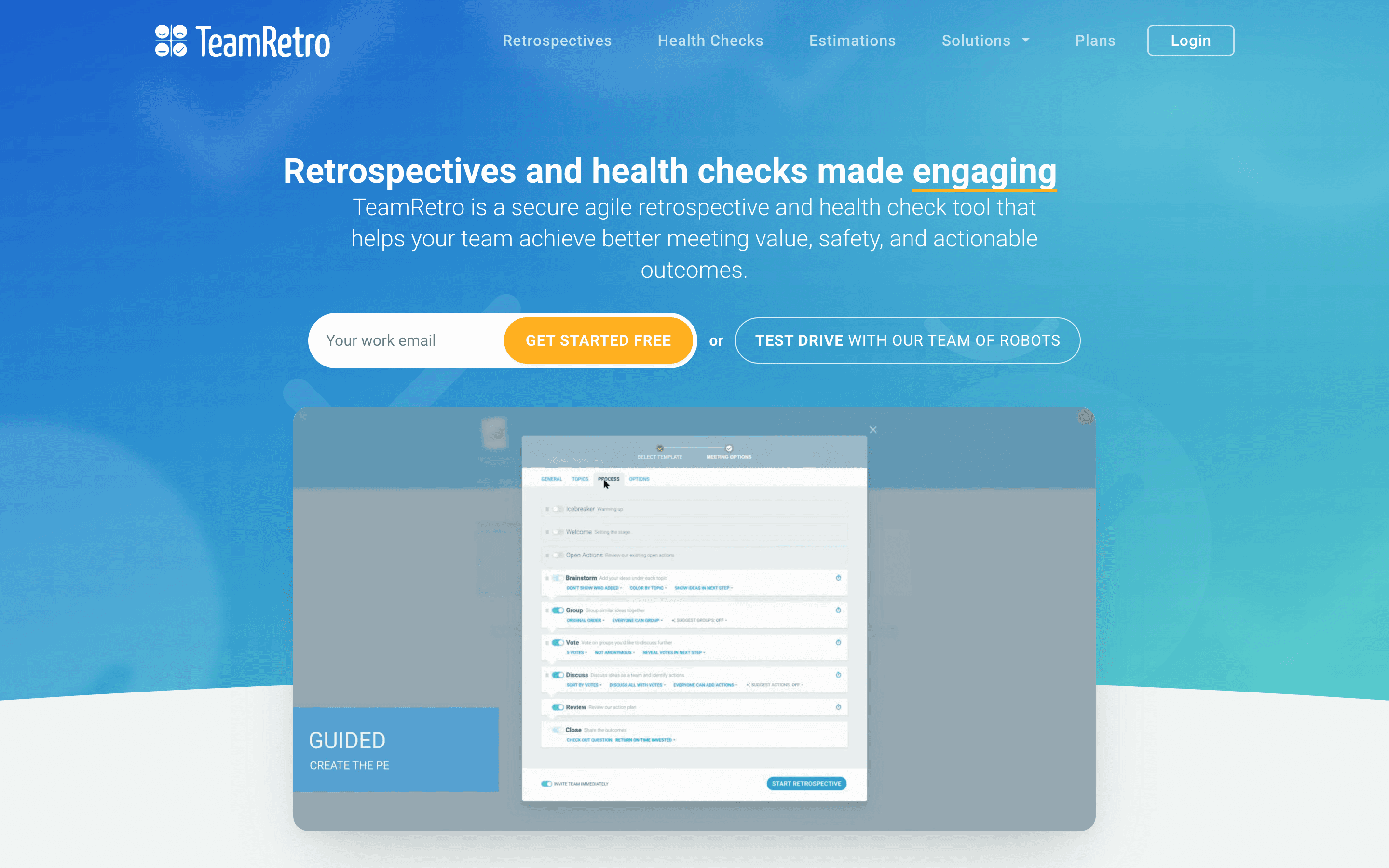
The retro basics overlap almost entirely: anonymous brainstorming, dot voting, timers, action items, guided facilitation. Parabol runs Reflect > Group > Vote > Discuss. TeamRetro uses Set the Stage > Brainstorm > Group > Discuss > Actions. Both keep everyone on the same step.
The real split happens outside of retros. Parabol includes Sprint Poker that imports Jira tickets via JQL, GitHub issues, and GitLab issues, then syncs estimates back to your backlog automatically. It has async standups with customizable questions and Slack/Teams notifications. TeamRetro added a Planning Poker tool in early 2026, but it's more basic: six estimation decks with no confirmed ticket import or auto-sync back to Jira.
TeamRetro pulls ahead on retro depth. It tracks sentiment across meetings with AI-powered timeline analysis and heat maps. Its health check tool is a standalone feature, not just a poll bolted onto retros. Four pre-built models, 15 maturity model templates, trend tracking over time. Parabol's health checks are emoji-based polls at the start of retros, which is useful but not in the same category.
TeamRetro's health check system is genuinely deeper than most competitors. Four pre-built models, 15 maturity templates, and cross-meeting trend tracking give engineering leaders data they can actually act on. Parabol's emoji polls don't come close here.
TeamRetro also has touches that experienced facilitators appreciate: Lean Coffee format, music playback during brainstorming, kudos badges, quick polls, and a parking lot for off-topic items. These sound minor, but they add up across 50+ retros a year.
Pricing Comparison
These two use different pricing models, and the math matters depending on your team size.

Parabol
Inactive users drop off automatically
- Retros, poker, and standups included
- Free tier: 2 teams, 10 meetings/mo
- AI features on paid plan
- Enterprise: custom pricing, SSO, self-hosting

TeamRetro
Per team — up to 25 members
- SSO/SAML on all paid plans
- 3 teams for $60/mo, 6 for $90/mo
- SOC 2 included on Enterprise
- No free tier — 30-day trial only
For a single team of 8 people, Parabol costs $64/month. TeamRetro costs $25/month. TeamRetro wins on raw price for small teams, and unlike Parabol's free plan (2 teams, 10 meetings/month, 30-day history), TeamRetro's Single Team plan includes unlimited retros and health checks with no history limits.
But TeamRetro's model gets expensive with multiple teams. Three teams cost $60/month, six teams $90/month, and every team beyond six adds $15/month. A company with 10 teams and 80 active users pays ~$150/month on TeamRetro versus $640/month on Parabol. That's a big gap at the organizational level, though it narrows if Parabol also replaces your planning poker and standup tools.
TeamRetro includes SSO/SAML on every paid plan starting at $25/month. Most competitors, including Parabol, gate SSO behind Enterprise pricing. If SSO is a hard requirement and you're not on an enterprise budget, TeamRetro stands out.
Ease of Use
TeamRetro's interface is more polished for retros specifically. The step-by-step facilitation walks you through each phase, presentation mode keeps everyone synced, and the board layout is clean. Participants can toggle between anonymous and named mode within a single meeting, which is a nice touch. The 56+ templates are organized into clear categories. First-time facilitators can run a decent retro without any prep.
Parabol covers more ground, so there's more to navigate. The meeting selector (retro, poker, standup, check-in) adds a layer of complexity. But the guided flow within each meeting type is well-structured. The friction point is account creation — every participant needs an account, whereas TeamRetro lets people join with just a link during the trial period.
For pure retro facilitation, TeamRetro feels more refined. For teams running multiple ceremony types, Parabol's unified platform saves the context-switching tax of using separate tools.
Integrations
Parabol goes deeper on dev tool integration. It imports tickets from Jira, GitHub, GitLab, Linear, and Azure DevOps. Sprint Poker estimates sync back to your issue tracker automatically, with story points landing in Jira and labels in GitHub. Action items from retros push to your tracker as new issues. Slack and Microsoft Teams handle notifications and summary sharing.
TeamRetro connects to more tools overall (15 integrations vs Parabol's ~12), but all of them are export-only. Action items push to Jira, GitHub, Linear, Azure DevOps, Trello, Asana, Basecamp, ClickUp, Monday.com, Shortcut, and GitLab. Meeting summaries publish to Slack, Teams, Confluence, and Notion. The Jira integration got two-way sync for action status in December 2025. But there's no ticket import — you can't pull your backlog into TeamRetro the way you can with Parabol's Sprint Poker.
If your workflow is "run retros, push action items to Jira, move on," TeamRetro's broader export list probably has your tool covered. If you need to pull tickets into estimation sessions and have estimates land back in your tracker without copy-pasting, only Parabol does that.
AI and Automation
Parabol's AI groups related reflections during the reflect phase using semantic similarity, then auto-names each cluster. On teams over 10, this saves 5-10 minutes of manual drag-and-drop sorting. AI summaries generate after meetings and ship to Slack or email. On the Team plan, you also get AI icebreaker generation and AI-suggested group naming.
TeamRetro's AI covers different territory. Sentiment analysis tracks team mood across meetings with heat maps and trend lines — something Parabol doesn't attempt. AI-generated icebreaker questions (powered by ChatGPT) start each session. AI meeting summaries highlight key metrics and action outcomes. AI also suggests groupings during the affinity mapping phase.
Both tools have AI grouping now. Neither does per-card sentiment or predictive analytics. TeamRetro's sentiment tracking gives you longitudinal data about how your team feels over time, which is more useful for eng managers writing quarterly reports than for the facilitator running Friday's retro. Parabol's grouping automation saves more time in the actual meeting.
Who Should Choose Which?
Choose Parabol if…
- You run retros, planning poker, and standups and want one tool for all three
- You need ticket import from Jira, GitHub, or GitLab with auto estimate sync back to your backlog
- Open-source matters — you want to self-host or your procurement team requires source code review
- You value per-user pricing where inactive members drop off your bill automatically
Choose TeamRetro if…
- SOC 2 Type II, SCIM provisioning, and IP whitelisting are hard requirements
- You want deep health check tracking with maturity models and trend data over time
- SSO/SAML on a $25/month plan matters more than ceremony breadth
- Your team only runs retros and health checks — standups and poker happen elsewhere
- You need 15+ project management integrations for exporting action items
Final Recommendation
Parabol is the more complete ceremony tool. Retros, poker, standups, and health checks in one platform, with dev tool integrations that flow data both directions. For a team that runs the standard Scrum cadence and tracks work in Jira or GitHub, it replaces two or three separate subscriptions. The open-source codebase matters too, especially for regulated industries that need source code audits before procurement signs off.
TeamRetro is the better retro tool if retros are all you need. More templates, sentiment tracking over time, serious health checks, and a compliance posture that Parabol is still working toward. If your org already has separate poker and standup solutions and just needs strong retrospectives with SOC 2 on day one, TeamRetro delivers that.
Parabol does more for less. TeamRetro does retros better and checks more enterprise boxes. Most teams still figuring out their ceremony stack should start with Parabol. Teams deep in enterprise procurement with compliance checklists should look at TeamRetro first. Either way, check out our guide to running effective retros before your next session.