

Quick Verdict
These two tools come at retrospectives from completely different angles. Kollabe bundles retros, planning poker, and standups into one platform with AI assistance and flat pricing. Retrium is a retro-only tool built for enterprises that want structured, guided facilitation.
Most teams will get more out of Kollabe for less money. Enterprise organizations that need hand-held facilitation workflows and care about having Adobe and Amazon on the vendor's client list should look at Retrium.
Feature Comparison
Both run solid retros, but the product philosophies are night and day.
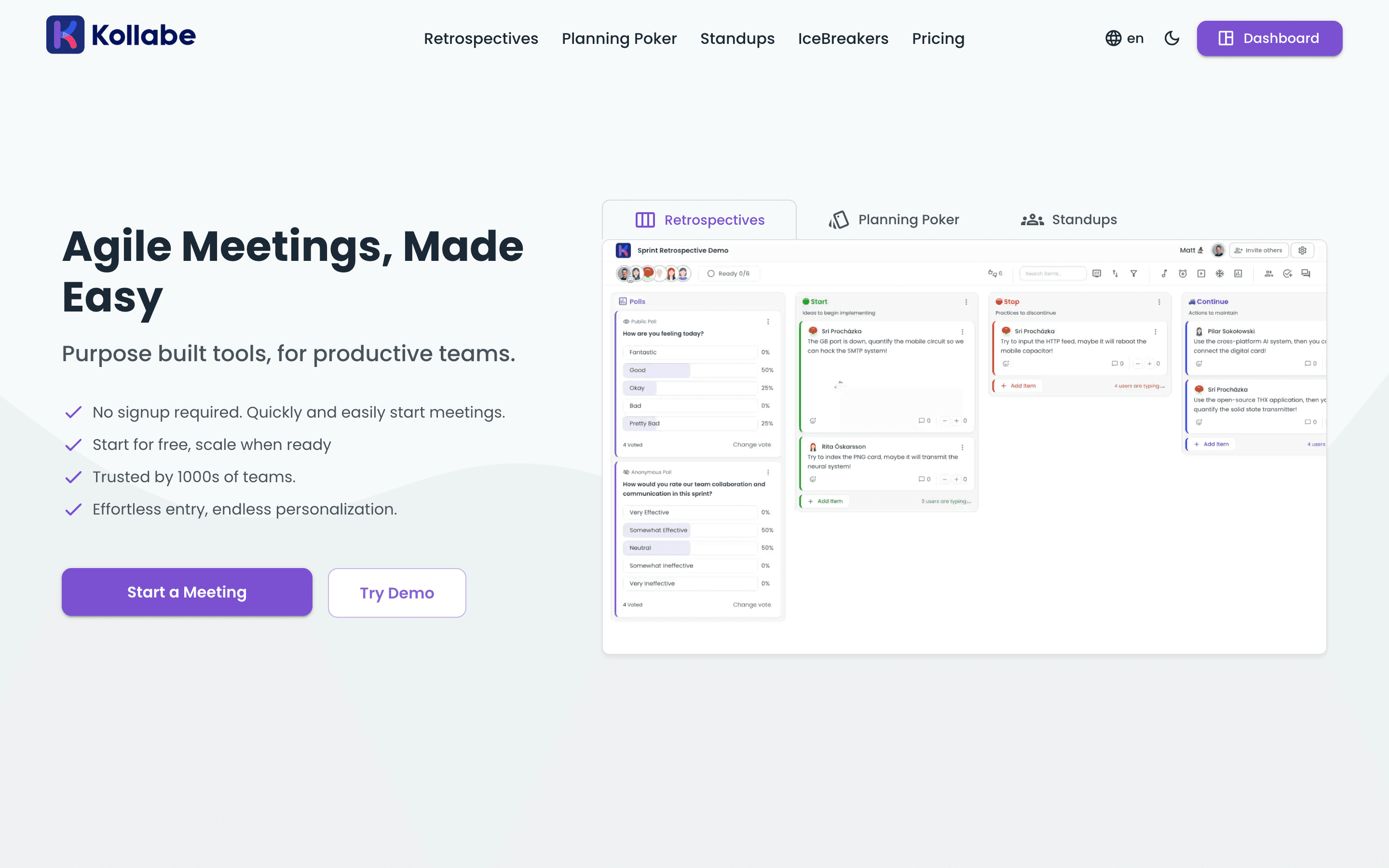
Kollabe gives you retros, planning poker, and standups in one place. The AI groups related feedback cards on its own and generates session summaries with suggested action items. You get 1,000+ retro templates (plus an AI generator for custom ones), icebreakers, and anonymous feedback. For facilitators, the automation cuts out the most tedious parts of running a retro.
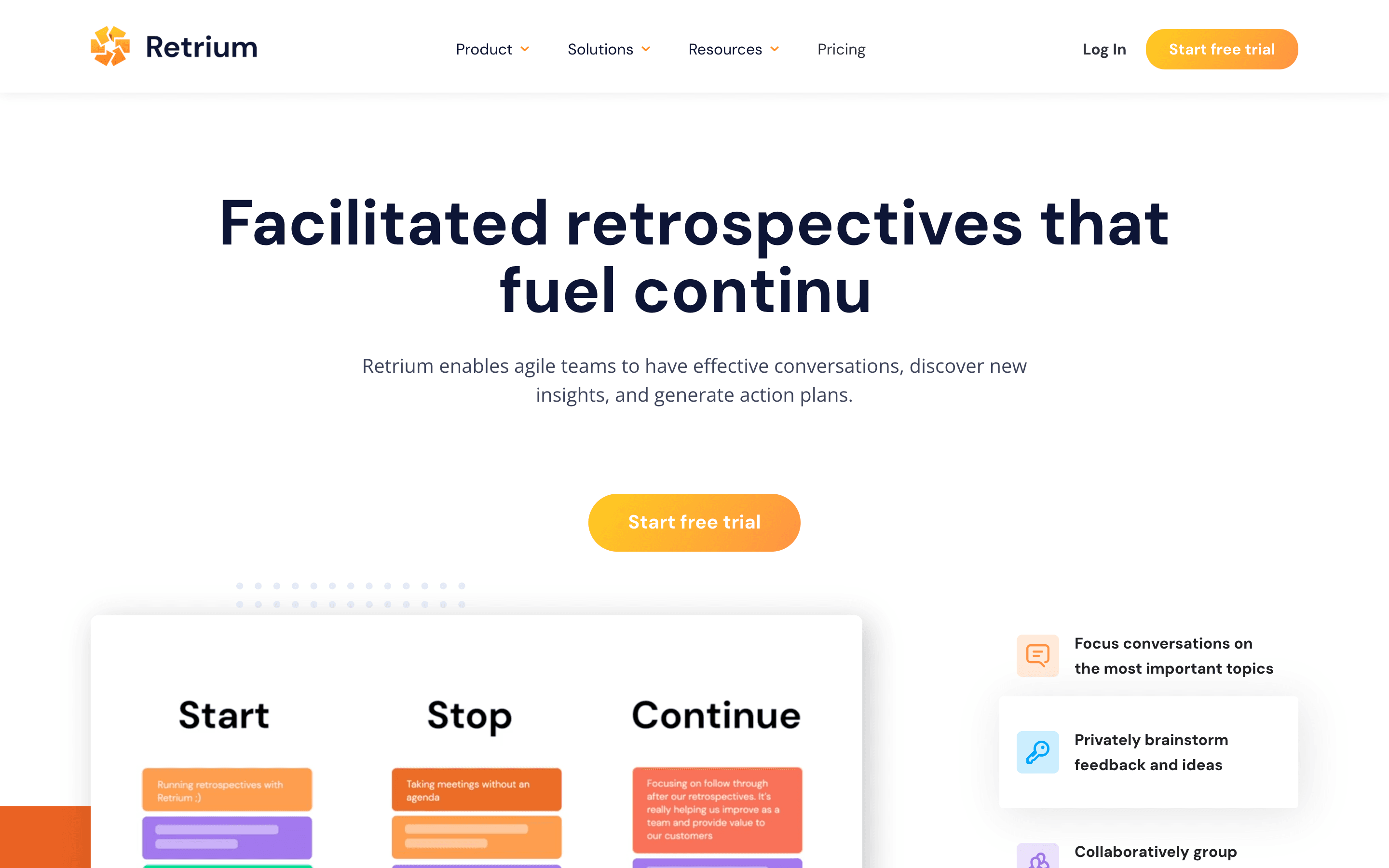
Retrium's standout feature is guided facilitation. Instead of handing you a blank board, it walks your team through brainstorming, grouping, voting, and action items step by step, with instructions and time limits at each phase. This is genuinely useful for newer Scrum Masters or teams whose retros tend to spiral. Retrium also has Team Radar for tracking team health over time, and it supports both async and real-time participation.
Retrium's guided workflow is genuinely best-in-class for less experienced facilitators. But it comes with a trade-off: no planning poker, no standups, no icebreakers. You need separate tools for those, and despite the premium price, there are no AI features at all.
Pricing Comparison
This is often what settles the decision.

Kollabe
Flat rate per team — any team size
- Retros, planning poker, and standups
- AI grouping and summaries included
- Free tier: 10 participants, 7-day history
- Enterprise: SSO/SAML and dedicated support

Retrium
Per team room — unlimited users per room
- Guided facilitation workflow
- Team Radar health checks
- No free tier (30-day trial only)
- Enterprise pricing requires sales call
So the math: Kollabe gives you retros, poker, and standups for $29/month with a free tier. Retrium gives you retros only for $39/month with no free option. For teams watching their budget, this isn't close.
Ease of Use
Retrium has a real advantage here for less experienced facilitators. The step-by-step workflow removes all guesswork about what happens next. You don't need to be a seasoned Scrum Master to run a productive session. The tool provides the structure.
Kollabe is more flexible. Facilitators control the flow and decide when to move between phases. The AI compensates by handling the time-consuming grouping and summarizing, so you spend less total effort even without the guided rails. Experienced facilitators will prefer this freedom. Newer ones might need a session or two to get comfortable.
Both have clean interfaces and run in the browser. Retrium's onboarding is smoother for first-timers. Kollabe's AI means less work overall once you know your way around.
Integrations
Both connect to Jira. That is table stakes.
Kollabe goes further with GitHub, Linear, Confluence, and Azure DevOps. If your team does not live in the Atlassian world, Kollabe is the more practical choice. GitHub Issues and Linear users can push action items directly into their existing workflow.
Retrium has expanded beyond Jira. There is a full Slack app that lets team members join retros, get real-time session updates, and receive weekly action item summaries every Monday. Action items also export to GitHub, Trello, ClickUp, and Asana. That said, the non-Jira integrations are lighter — action item export only, no two-way sync. No Confluence, Linear, or Azure DevOps support. Kollabe still has the edge here for teams with a mixed toolchain.
If your team uses Linear or Azure DevOps, Retrium has no support for either. Kollabe is the only retro tool on the market with native integrations for both.
AI and Automation
Kollabe wins this one decisively.
Auto-grouping during retros, theme identification, sentiment analysis, and summary generation with suggested action items. Available on the Premium plan ($29/month). For a team of 15+ people generating dozens of cards, this saves real time every single sprint.
Retrium has no AI features at all. The guided workflow adds structure, but it doesn't reduce the cognitive work of reading through 80 cards and figuring out which ones say the same thing. The facilitator still does all of that by hand.
For a tool charging $39/month in 2026, having zero AI is a notable gap. Teams are starting to expect auto-grouping and summary generation as standard, and Retrium hasn't kept up.
Who Should Choose Which?
Choose Kollabe if…
- You want one subscription covering retros, poker, and standups
- You want AI doing the grouping and summarizing
- Your team uses GitHub, Linear, or Azure DevOps
- You don't want tool costs scaling with headcount
- You need a free tier to evaluate before committing
Choose Retrium if…
- Enterprise procurement cares about the vendor's client list (Adobe, Amazon, Siemens)
- You need guided facilitation for rotating or inexperienced facilitators
- Async participation matters for distributed teams across time zones
- You value Team Radar health tracking for continuous improvement
- Budget is not the primary concern and you don't need poker or standups in the same tool
Final Recommendation
For most teams, Kollabe is the better buy. More ceremony types, lower price, AI features Retrium doesn't have, and a free tier to evaluate with.
Retrium earns its place with enterprises that need guided facilitation and recognized vendor credentials. But even for those teams, the gap is narrowing as Kollabe's enterprise features mature. If you're starting fresh or reconsidering your retro tooling, try Kollabe's free tier first. You might find you don't need to pay a premium for Retrium's guided approach.