

Quick Verdict
These two tools cover almost identical ground — retros, planning poker, standups — but they disagree about how a retro should actually run.
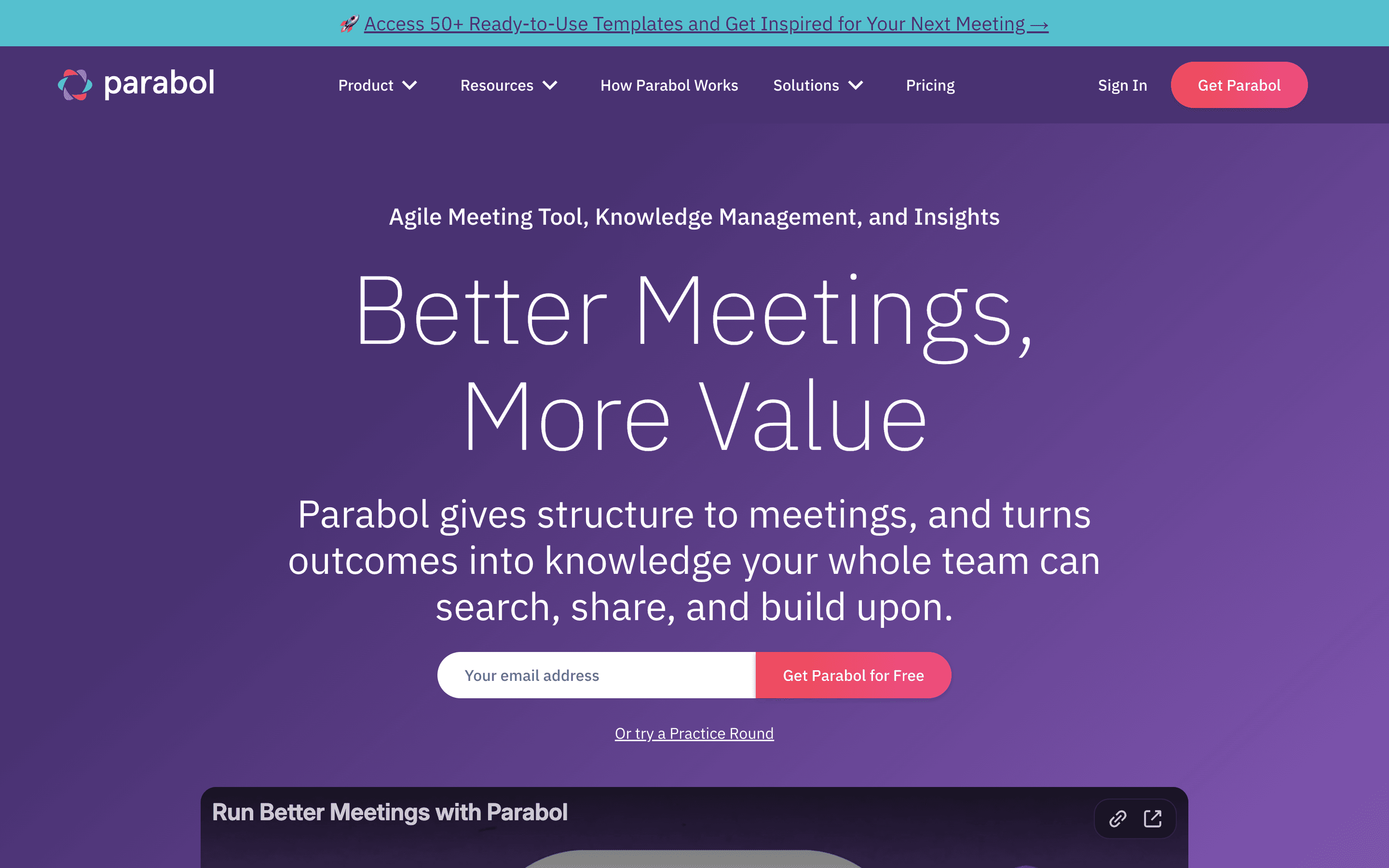
Parabol forces every retro through a rigid four-step flow: Reflect, Group, Vote, Discuss. You can't skip steps. You can't let people just drop cards on a board and come back later to read them. Every session is a guided meeting. That's great if your team needs training wheels on facilitation. It's annoying if you just want a quick async pulse check or an open feedback board.
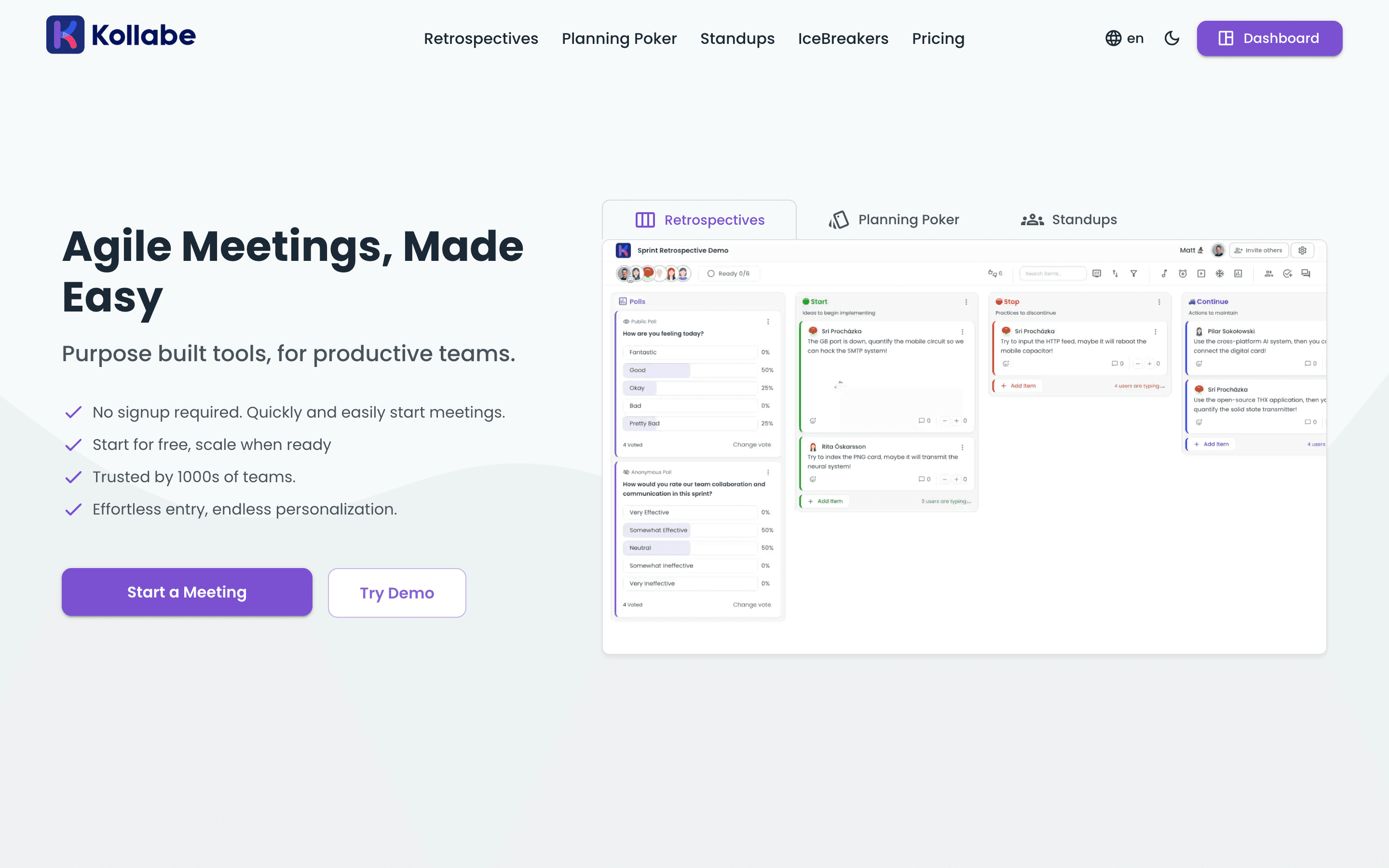
Kollabe lets you choose. Run a guided retro with phases, timers, and AI grouping — or just share a board link and let people add cards whenever. On a team of three developers, a formal four-phase retro is overkill. You just want a board.
Feature Comparison
Both tools check the big boxes: anonymous feedback, voting, templates, action items, timers. Both have AI summaries and AI grouping. Both do planning poker with Jira and GitHub imports. The feature tables look almost identical until you start actually using them.
Kollabe's retro feature set goes deeper. Inline polls, a drawing tool, themed retros with 30+ backgrounds, GIF and media support, kudos, and over 1,000 templates including an AI generator. It also exports to PDF, Markdown, JPEG, CSV, JSON, and Confluence — six formats versus Parabol's CSV-and-email approach.
Parabol's edge is health checks. It has a dedicated team health poll baked into the retro flow (paid plans only) that Kollabe doesn't match as a standalone feature. Parabol is also open-source under AGPL, which matters if your org has strict procurement policies or you want to self-host. Kollabe is cloud-only.
The biggest practical difference isn't on any feature table. Parabol locks every retro into a Reflect > Group > Vote > Discuss sequence. Kollabe lets you run that same guided flow or skip straight to an open board. For small teams that rotate between structured retros and quick async feedback rounds, that flexibility saves real time every sprint.
Parabol also drops inactive users from billing automatically after 30 days and has Slack and Microsoft Teams notifications. Kollabe has neither Slack nor Teams integration — a real gap if your team lives in those tools.
Pricing Comparison
This is where the decision gets interesting. Parabol charges per active user. Kollabe charges per team.

Kollabe
Flat per team — same price for 5 or 50 users
- Retros, poker, standups, icebreakers included
- Unlimited participants and history
- All AI features included
- Free tier: 10 participants, 7-day history

Parabol
Per active user — inactive users drop off
- Retros, poker, standups, health checks
- AI summaries and grouping on paid plans
- Unlimited meetings and history
- Free tier: 2 teams, 10 meetings/mo
Do the math for your team size. At 4 active users, Parabol costs $32/month — about the same as Kollabe's $29. At 8 users, Parabol runs $64/month. At 15, it's $120. Kollabe stays at $29 regardless.
Parabol's free tier is more restrictive than it looks: 2 teams, 10 meetings/month, 30-day history, and you lose AI grouping, AI summaries (beyond 3), and health checks. Kollabe's free tier caps at 10 participants with 7-day history but doesn't gate AI features behind a paywall.
The catch with Kollabe: each Space is one team. Three teams means three subscriptions ($87/month). For a single team of 10+, Kollabe wins easily. For an organization with 20 small teams, Parabol's per-user model might actually come out cheaper.
Ease of Use
Parabol's guided flow is opinionated by design. You create a meeting, pick a template, and the app walks everyone through Reflect, Group, Vote, Discuss in order. You can't jump ahead. You can't go back. The facilitator advances phases when the team is ready. If you've never facilitated a retro before, the hand-holding helps.
The downside is that Parabol requires accounts for everyone. No anonymous link sharing. Every participant signs up, logs in, gets invited to a team. That's friction. If you're running a retro with contractors or stakeholders who join once, asking them to create a Parabol account feels heavy.
Kollabe doesn't require signups for participants — share a link and they're in. The retro interface adapts to how you want to run things. Turn on guided phases for a structured session, or leave the board open for async feedback over a few days. That's not a minor UX detail. It's a different philosophy about what a retro can be.
Not every retro needs to be a 45-minute guided ceremony. Sometimes you just want a shared board where the team drops thoughts throughout the week. Kollabe supports both modes. Parabol only supports the guided meeting.
Integrations
Both tools connect to Jira, GitHub, Linear, and Azure DevOps for ticket imports and estimate syncing. Both export to Confluence. The dev tool coverage is comparable.
Where Parabol pulls ahead: Slack and Microsoft Teams. Meeting reminders, summary notifications, async standup nudges, all piped into the channels where your team already talks. Parabol also integrates with GitLab (including self-managed instances on Enterprise) and Mattermost, which Kollabe doesn't support.
Kollabe's integration gaps are real. No Slack, no Teams, no Trello, no GitLab. If your team coordinates through Slack and expects retro summaries to show up in a channel automatically, Parabol is the only option here. Kollabe's new public API (launched February 2026) could close some of these gaps through custom automations, but it's early days.
AI and Automation
Both tools offer AI grouping and AI summaries. Parabol clusters reflections using semantic similarity and auto-names the groups. Kollabe does the same, plus sentiment analysis tracking mood trends across sprints. Kollabe also generates AI-powered PDF reports — something Parabol doesn't do (it's CSV and email summaries only).
Kollabe's AI template generator is unique. Describe what you want your retro to focus on, and it builds a custom template. Parabol has 40+ templates but no AI generation. For teams that run retros every sprint and get bored of Start/Stop/Continue, this keeps formats fresh without manual template building.
Neither tool is pushing AI boundaries. But Kollabe uses it in more places — summaries, grouping, sentiment, template generation, PDF reports — while Parabol sticks to grouping and summaries.
Who Should Choose Which?
Choose Kollabe if…
- You want retros that flex between guided sessions and open feedback boards
- Your team is 5+ people and flat pricing at $29/month beats per-user fees
- You need export options beyond CSV — PDF reports, Markdown, JPEG, JSON
- You want AI template generation, sentiment tracking, and themed retros
- No-signup participation matters — share a link and people join immediately
Choose Parabol if…
- Your team needs Slack or Microsoft Teams integration for notifications and summaries
- Open-source and self-hosting matter for your procurement or compliance requirements
- You want structured facilitation guardrails that prevent skipping retro phases
- Your org has many small teams where per-user pricing scales better than per-team
- Team health checks are part of your retro workflow
Final Recommendation
For most teams under 15 people, Kollabe is the better pick. It costs less, does more with AI, and doesn't force every retro into a rigid four-phase meeting. Some sprints deserve a full guided retro. Others just need a quick board where people flag one thing that bugged them. Kollabe handles both. Parabol only handles the first.
Parabol earns its spot for teams that need Slack/Teams integration, care about open-source, or want the discipline of a guided flow they can't shortcut. It's a good tool — rated 4.6 for a reason. But the forced meeting structure, per-user pricing that climbs fast, and CSV-only exports make it harder to recommend over Kollabe's $29 flat rate with full AI and six export formats.
If your team runs retros differently depending on the sprint — sometimes a ceremony, sometimes just a feedback page — Kollabe is built for that. Parabol assumes every retro is a meeting. That assumption doesn't hold for a lot of teams.