

Quick Verdict
Both of these tools do retros and only retros. No planning poker, no standups. The difference is philosophy.
EasyRetro hands you a board and gets out of the way. Huge template library, dead-simple interface, and a free tier. Retrium walks your team through each phase of the retro with guided facilitation, tracks team health over time, and supports async participation. At $38/month vs $39/month, the pricing is nearly identical at the single-team level.
Since price isn't a differentiator anymore, the decision comes down to approach. Small teams that want simplicity should go with EasyRetro. Mid-size and enterprise teams that want retros to actually drive measurable improvement will get more from Retrium's structured approach.
Feature Comparison
Same category, very different products.
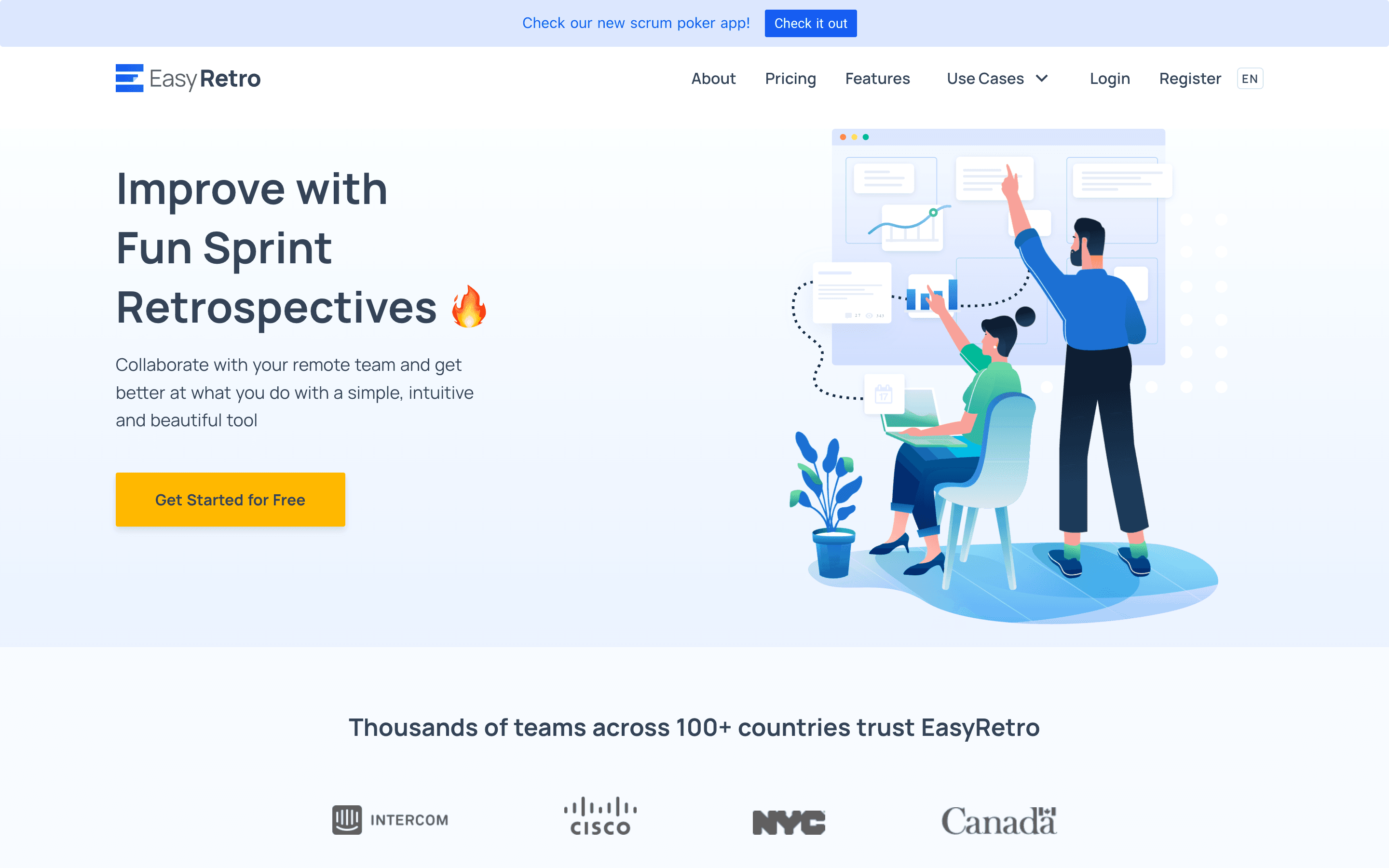
EasyRetro gives you a board and lets you go. Over 200 templates: Start/Stop/Continue, Mad/Sad/Glad, 4Ls, Sailboat, and plenty of creative formats to keep things from getting stale sprint after sprint. There's a custom template builder too. The interface is minimal on purpose. Add cards, vote, discuss. The facilitator runs the timer and manages the flow themselves.
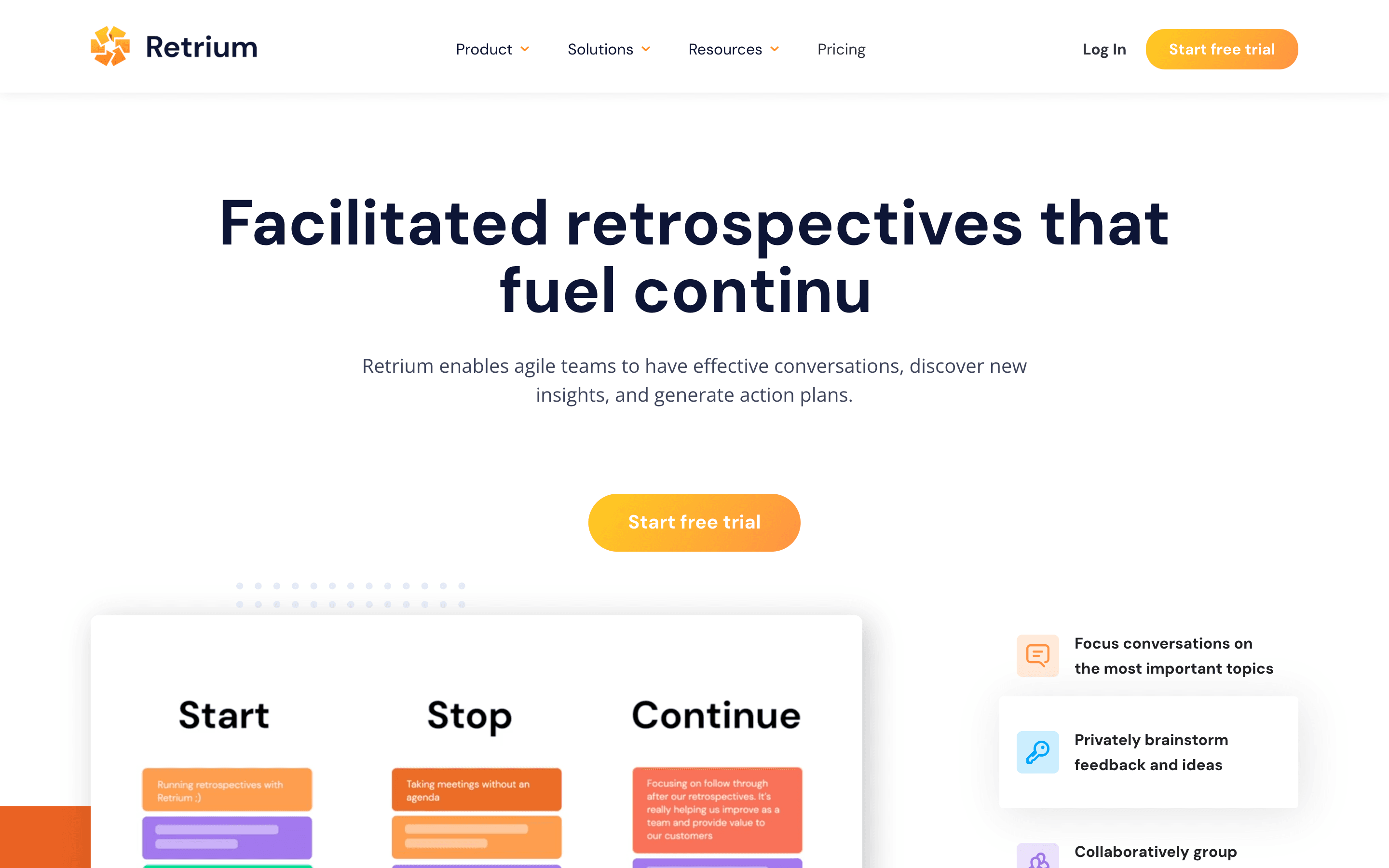
Retrium is more opinionated. It guides teams through brainstorming, grouping, voting, and action items with instructions and time limits at each step. The facilitator doesn't need to figure out pacing or transitions. This is Retrium's biggest selling point and the main reason enterprises pick it over simpler tools.
Retrium's Team Radar tracks team sentiment across categories over time. If you're an engineering manager trying to prove that retro action items are actually making a difference, this longitudinal data is the only way to back that up with numbers. EasyRetro has nothing like it.
On async, Retrium lets distributed team members submit feedback on their own schedule before a live discussion. EasyRetro boards are real-time collaborative, but there's no dedicated async workflow for teams spanning time zones.
Pricing Comparison
This is where the conversation gets real.

EasyRetro
Team plan — flat rate, not per-user
- 5 boards/month, 1 team
- Jira, Confluence, Slack integrations
- Analytics and multi-format export
- Free tier: 1 public board/month

Retrium
Per team room — unlimited users per room
- Guided facilitation workflow
- Team Radar health checks
- Async retro participation
- No free tier (30-day trial)
For one team, there's essentially no price difference. For organizations with several teams, it depends on how you structure things. EasyRetro's flat-rate model can work out differently at scale, but you'll hit board limits on lower tiers. Retrium's per-room pricing scales linearly. At these prices, the decision should be about features, not cost.
Ease of Use
EasyRetro is about as simple as a retro tool can get. Join a board (no account needed), add cards, vote. Ten years of polish have removed every unnecessary click. A brand new team member is productive in their first session without any explanation.
Retrium takes more getting used to. The guided workflow means facilitators advance through phases manually, which adds a bit of overhead compared to EasyRetro's open-board approach. But that structure is the whole point. If your retros have a pattern of going off the rails, with discussions that wander, loud voices dominating, or action items that never materialize, Retrium's guardrails fix those problems.
Experienced facilitators who already run tight retros will prefer EasyRetro's flexibility. Teams with rotating Scrum Masters or inconsistent facilitation will benefit from Retrium's scaffolding — the quality of the retro stops depending on who's running it.
Integrations
EasyRetro's Atlassian integrations are mature. Jira, Confluence, Trello, all well-tested after years of iteration. Slack handles notifications. Export options are thorough: PDF, CSV, PNG, Excel, and DOCX.
Retrium connects to more tools than most people expect. Jira Cloud handles action item export with cross-reference links. The Slack app goes deeper than most — team members can join retros from Slack, track progress in real time, and get weekly Monday summaries of outstanding action items. Retrium also exports action items to GitHub, Trello, ClickUp, and Asana. No Confluence support, though, which matters if your team relies on it for documentation.
Neither tool connects to Linear or Azure DevOps. If your team lives outside the Atlassian and GitHub ecosystem, Kollabe covers those.
AI and Automation
EasyRetro shipped AI-generated board summaries in January 2024. After a session wraps, you can generate a concise summary of the board automatically. It saves the facilitator from writing up notes by hand. That said, there's no AI grouping — sorting related cards into themes is still manual work.
Retrium doesn't have AI summaries or grouping. Everything is facilitator-driven.
Retrium's guided workflow does help by making the grouping phase explicit and structured. You won't skip it or leave it as an afterthought. But the actual work of reading, comparing, and merging similar cards? Still entirely on the facilitator in both tools.
If AI-assisted facilitation is a priority, both tools leave you wanting. Kollabe offers auto-grouping and summary generation if that's a dealbreaker.
Who Should Choose Which?
Choose EasyRetro if…
- Your team needs a simple, reliable retro board
- Your facilitators are experienced and don't need guided workflows
- You want 200+ templates to keep formats fresh
- You're in the Atlassian ecosystem (Jira, Confluence, Trello)
- You want a free tier to test the tool before committing
Choose Retrium if…
- You want retros to produce measurable outcomes, not just sticky notes
- Your facilitators are inconsistent, inexperienced, or rotating
- You need async participation for distributed teams
- Team Radar health tracking matters for continuous improvement
- Enterprise procurement needs brand-name customers (Adobe, Amazon, Siemens)
Final Recommendation
It comes down to what you're optimizing for.
EasyRetro gives you a simple, flexible retro board with the biggest template library on the market. At $38/month, it's nearly the same price as Retrium's $39/month, so this isn't a budget decision anymore.
Retrium gives you guided facilitation, health tracking, and async workflows for essentially the same money. That's worth it for mid-size and enterprise teams that treat retros as a real continuous improvement practice — not a box to check at the end of each sprint.
Pick EasyRetro if you want simplicity and a massive template library. Pick Retrium if you want structured facilitation and longitudinal team health data. The price is a wash either way.