

Quick Verdict
Parabol does more. EasyRetro does less but has been doing it longer.
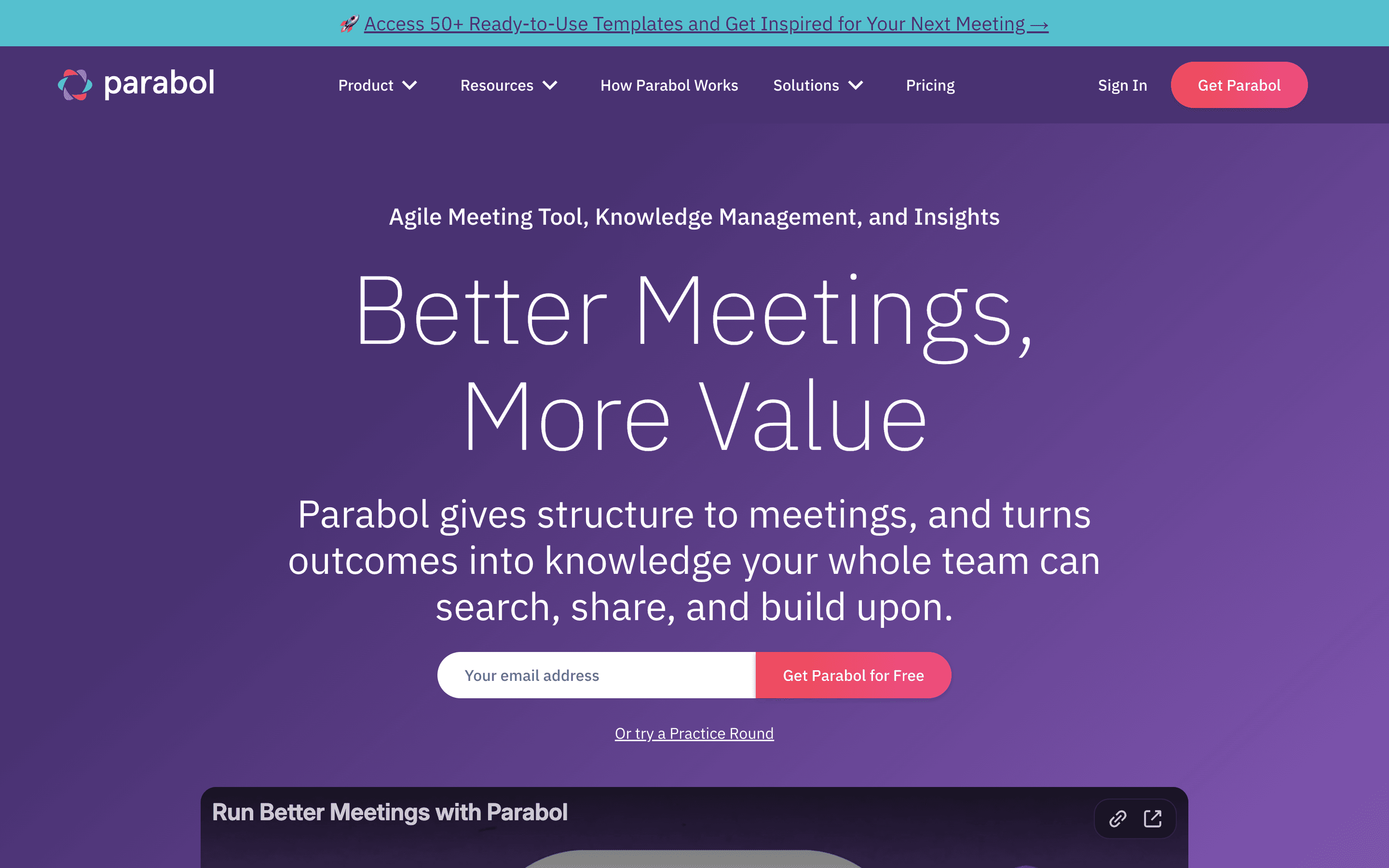
If your team runs retros alongside planning poker and standups, Parabol handles all three without needing extra subscriptions. It's open-source, has AI that actually helps during the grouping phase, and its per-user pricing scales well. For most agile teams running the full suite of ceremonies, Parabol is the better pick.
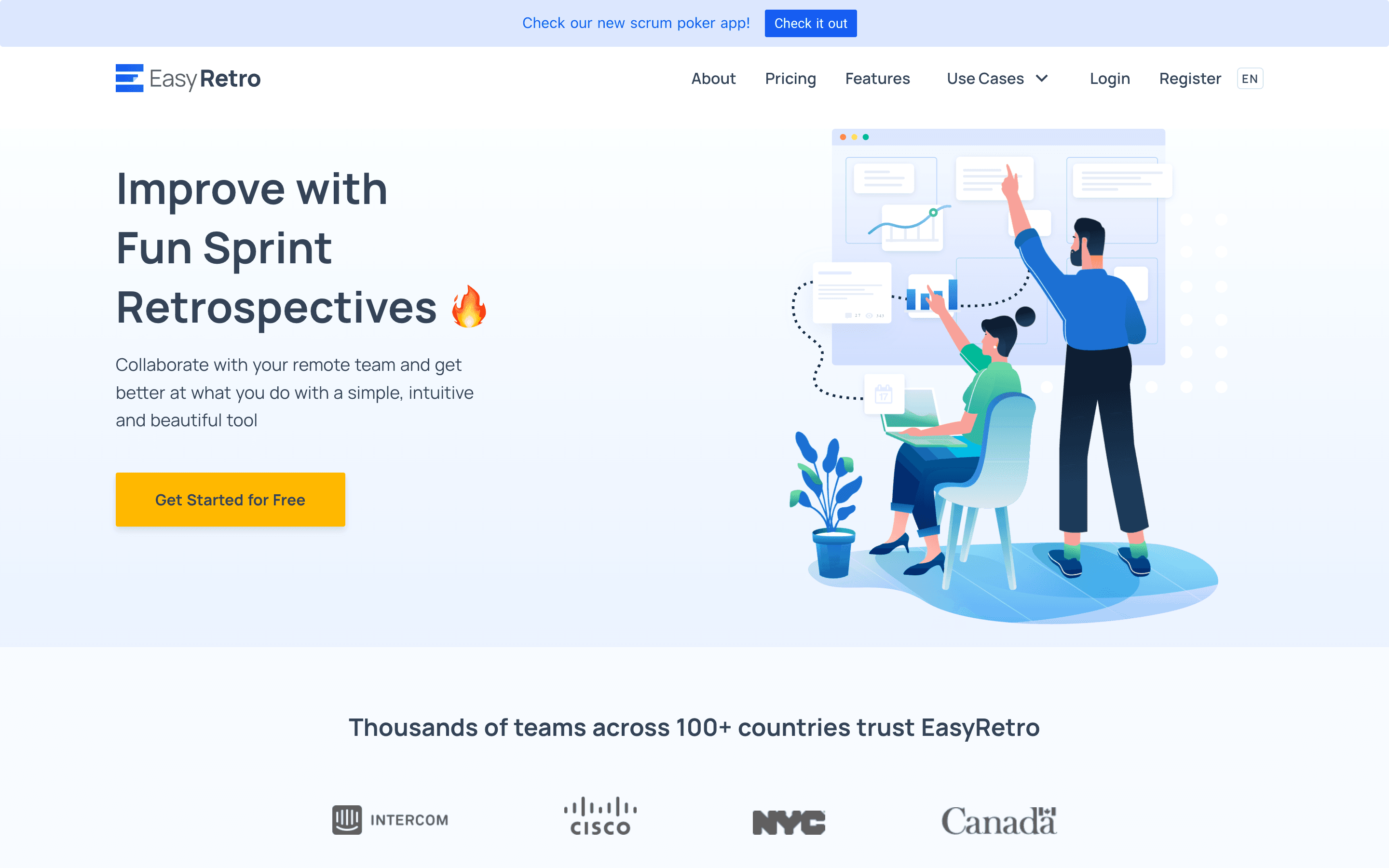
EasyRetro makes sense for teams that only need a retro board. It's been around since 2015, has 200+ templates, and participants don't even need accounts to join. If you run a quick retro every two weeks and don't need poker or standups baked in, EasyRetro is dead simple and gets the job done.
Feature Comparison
The retro basics overlap: anonymous feedback, voting, timers, action items, templates. Both added AI summaries. Where they diverge is how much they try to do.
Parabol's biggest advantage is AI grouping. During the reflect phase, it clusters related cards and auto-names the groups. Anyone who's facilitated a retro with 15+ people knows the grouping step is where momentum dies. You're staring at 80 cards, trying to figure out which 15 say the same thing in slightly different words. Parabol handles that automatically. EasyRetro still requires manual drag-and-drop merging, which is fine for a team of 5 but painful at 20.
The grouping phase is where retros lose momentum on larger teams. Parabol automates it with semantic similarity clustering. EasyRetro still requires manual drag-and-drop merging — manageable at 5 people, painful at 20.
Beyond retros, Parabol includes Sprint Poker with Jira/GitHub/GitLab ticket import and auto-sync of estimates back to your backlog. Async standups with customizable questions. Team health checks on paid plans. EasyRetro doesn't touch any of these. It's purely a retrospective tool.
Where EasyRetro pulls ahead: its 200+ template library is genuinely the deepest in this category, it supports 8 languages natively, and it has creative touches like card drawing, GIF support, and customizable board backgrounds that make retros feel less clinical. Parabol has 40+ templates but sticks to the classics.
Pricing Comparison
These tools use completely different pricing models, which makes direct comparison tricky.
Parabol charges $8/active user/month on its Team plan. "Active" means users inactive for 30+ days automatically drop off your bill. The free Starter plan gives you unlimited users but limits you to 2 teams, 10 meetings/month, and 30-day history. For a team of 10 running weekly retros plus poker, you're looking at roughly $80/month.
EasyRetro charges a flat monthly fee regardless of team size. The Team plan runs $38/month for 5 boards/month and 1 team. Business is $60/month for 15 boards and 3 teams. Enterprise hits $90/month for 30 boards, 6 teams, and SAML SSO.

EasyRetro
Team plan — flat rate, not per-user
- 5 boards/month, 1 team
- Business at $60/mo for 15 boards, 3 teams
- Enterprise at $90/mo adds SAML SSO
- Free tier: 1 public board, 3 columns max

Parabol
Team plan — inactive users drop off automatically
- Retros, poker, and standups included
- AI grouping and summaries
- Unlimited meetings and history
- Free tier: 2 teams, 10 meetings/mo, 30-day history
For very small teams (under 5 people), EasyRetro's $38/month flat rate is cheaper than Parabol's per-user billing. But EasyRetro's board limit matters — 5 boards per month means 5 retros. If your team runs weekly retros, you'll need the $60 Business plan. At that price, a team of 5 on Parabol costs $40/month and gets unlimited meetings plus poker and standups included.
The pricing crossover is around 4-5 users. Below that, EasyRetro's flat rate wins on cost. Above that, Parabol's per-user model at $8/active user often comes out cheaper — and you get retros, poker, and standups instead of just retros.
Ease of Use
EasyRetro is simpler to pick up. Participants click a link, type a name, and start posting cards. No signup required. The interface is stripped down to boards, columns, and cards. A decade of iteration has removed every unnecessary click.
Parabol asks participants to create an account, which adds friction. Once inside, the guided meeting flow (Reflect > Group > Vote > Discuss) is opinionated but effective. New facilitators appreciate the structure — you can't accidentally skip the voting phase or forget to set a timer. The tradeoff is that Parabol's interface covers more ground (poker, standups, check-ins), so there's more to navigate.
For pure retro simplicity, EasyRetro wins. For teams that want guardrails on meeting flow, Parabol's guided facilitation is better.
Integrations
Parabol connects to more dev tools: Jira, GitHub, GitLab, Linear, Azure DevOps, Slack, Microsoft Teams, and Mattermost. The Jira and GitHub integrations go beyond notifications. You can import tickets directly into Sprint Poker, and estimates sync back automatically. Action items from retros push to your issue tracker.
EasyRetro's list is shorter: Jira (Cloud only, export), Confluence, Trello, Slack (notifications), and Microsoft Teams (embed only). No GitHub, no Linear, no Azure DevOps. No API either, so custom integrations and Zapier connections aren't an option.
EasyRetro has no API and no GitHub, Linear, or Azure DevOps integration. If your team tracks work outside the Atlassian ecosystem, Parabol is the only choice between these two.
If your team lives in the Atlassian ecosystem and only needs to push action items to Jira, EasyRetro covers that. If you track work in GitHub Issues, Linear, or Azure DevOps, Parabol is the only choice between these two.
AI and Automation
Parabol's AI does two things: grouping and summaries. The grouping feature clusters similar reflections using semantic similarity, which saves 5-10 minutes per session on larger teams. Summaries generate automatically after each meeting and can go to Slack or Teams.
EasyRetro added AI summaries in January 2024 and has an AI template generator that creates custom retro formats from a prompt. Both useful additions. But there's no AI grouping, and that's the step where facilitators actually lose time.
Neither tool does per-card sentiment analysis or predictive trend tracking. Parabol is ahead on AI, though mostly because it automates the one part of retros that nobody enjoys doing manually.
Who Should Choose Which?
Choose EasyRetro if…
- Your team runs retros and nothing else — you already have separate poker and standup tools
- You want 200+ templates and creative touches like GIF support and custom backgrounds to keep retros fresh
- Zero-signup participation is non-negotiable — external stakeholders join with a link and a name
- You're deep in the Atlassian ecosystem (Jira, Confluence, Trello) with Slack notifications
- Your team is under 5 people and EasyRetro's $38/month flat rate beats per-user pricing
Choose Parabol if…
- Your team runs retros, poker, and standups and you want one tool instead of three
- You need AI grouping to handle the clustering phase on teams of 10+ people
- You track work in GitHub, GitLab, or Linear and need deep integrations beyond the Atlassian ecosystem
- Open-source matters — you want to self-host or your org has strict software procurement policies
- Your team is 10+ people and per-user pricing at $8/active user/month scales better than flat-rate board limits
Final Recommendation
Parabol is the stronger tool for most agile teams in 2026. It handles retros, poker, and standups in one platform, its AI grouping solves a real facilitation problem, and $8/active user/month is reasonable. Being open-source with a self-hosting option is something no other retro tool in this category can claim.
EasyRetro is the right call if you want a simple retro board and nothing more. The template library, zero-signup access, and 8-language support make it a good fit for internationally distributed teams running lightweight retros. Don't write it off just because it does less.
If you're already paying for separate poker and standup tools, do the math. Parabol likely replaces all of them for less. If retros are your only ceremony and your team is tiny, EasyRetro at $38/month works — but it's no longer the budget option it used to be.